
Reader response
Myron Yaster MD

I received several reader comment on Intranasal naloxone here
From Sally Rampersad, MB, FRCA, Attending Anesthesiologist and Professor Dept of Anesthesiology and Pain Medicine Seattle Children’s Hospital and University of Washington School of Medicine commenting
My daughters and I were at a festival of play readings at Seattle Public Theatre, which is located right next to a park, lake and walking path in north Seattle. During intermission someone ran into the theater asking if anyone had naloxone on them and three or four people did. There is a homeless population who often camp near the lake and it is not uncommon to see people asleep/unconscious on benches close by, but someone had noticed a gentleman completely passed out, resp rate was about 6, with a pulse. Intra-nasal naloxone was administered and he was awake and doing well (a little confused, not aggressive), by the time the EMT’s arrived. The theater has added naloxone to their first aid kit and my daughters and I updated the supplies that we carry with us too.
From Ken Goldschneider MD FAAP Cincinnati Children’s
I keep a couple of vials of intranasal naloxone in the glove compartment of my car. I think about them from time to time and I’ve come to realize that it was an almost entirely useless thing to do. Having naloxone in the car if one is walking around in a park or large store means that the patient will long be dead before you can go and get it and administer it. It’s great if you happen to be driving by and see somebody on the ground and then can safely pull over to help, but when will that ever happen?
I also wondered about the storage instructions, which pretty much eliminate a car being a reasonable place to store it, given the wild fluctuations in cabin temperatures of cars exposed to the environment. But I ran across some literature to suggest that maybe the extremes of heat are not a deal breaker. Definitely not ideal, but there is reason to think that extremes of cold and heat (for up to a month, anyhow) will not destroy the naloxone.
Lai D, Pham AT, Nekkar Rao PP, Beazely MA. The effects of heat and freeze-thaw cycling on naloxone stability. Harm Reduct J. 2019 Feb 27;16(1):17. doi: 10.118612954-019-0288-4. PMID: 30813917; PMCID: PMC6391798.
Sending a prescription home along with prescriptions of opioids is something that we do frequently. Ohio state law mandates that a naloxone prescription be offered to patients taking over certain amounts of opioids, modified by concomitant use of other sedating agents or not. In this situation, I think it’s a great idea and it’s more than just performative.
But I wanted to emphasize something, by way of a very recent event. An acquaintance of mine here in my quiet suburb near Cincinnati heard that there was a person slumped over the steering wheel off their car just outside his house. He and a neighbor went out to see if they could help while waiting for the police to arrive. In the course of events, he walked behind the car to get to the driver’s side whereupon the unconscious driver suddenly awoke (quite disoriented), threw the car into reverse and ran him over. While this was unintentional, he was seriously injured (though is recovering). I tell this story to remind everybody of the first thing they teach you in CPR training: make sure that you and your surroundings are safe before you attempt to help anybody. Situational awareness is critical.
From Robert C. Pascucci MD, Boston Children’s Hospital
I still teach PALS, and often run a scenario about a kiddo who presents with hypoventilation/hypoxia because of a narcotic ingestion (Grandma just had her hip fixed, and that nice ortho doctor gave her some really good pain pills that she keeps in the candy dish near her TV). During the debriefing, I usually ask participants if they personally have nasal naloxone around for emergency use. A smattering of folks do; some even carry it with them. We discuss how to get it, and most folks (these are healthcare personnel) had no idea one could do get it just by asking at a pharmacy. Hopefully some of them will go get it.
BTW, as I’m typing this I’ve checked on my box of naloxone in the kitchen cabinet - it expired in 2024. I’ll stop by CVS later today …
From Chinwe Ajuba-Iwuji MD, Assistant Professor at Children’s National Hospital and the George Washington University School of Medicine and Health commenting on Substance Use Before Surgery? Does it really impact postoperative pain? here
I find the below highlighted statement to be unusual. Are there studies demonstrating that white, high income, adolescents are less at risk for SUD? Clinically, this hasn’t been my experience and to make such a statement necessitates data and proof.
First, a reality check: only 10.7% of this cohort (13 patients) were identified as high risk. That’s well below national estimates — the 2023 National Survey on Drug Use and Health puts alcohol use among 12–17 year olds at roughly 1 in 4, and marijuana use at nearly 1 in 5.(6) Our previous PAAD on anonymous pre-operative screening found similar rates with alcohol and marijuana use being reported at ~ 28 % and 21% of adolescents completing the survey.(7) The authors think the low rate reflects several factors: younger patients, a predominantly white, high-income cohort, and the possibility that some teens may have had concerns about confidentiality.”
Rita Agarwal MD, FAAP, FASA responds
The sentence in the PAAD reflects and paraphrases the article, as part of the limitations. The authors express concerns that this demographic, educated, higher-income, white demographic, may be less likely to admit to substance use, particularly because it is not clear if these questionnaires were confidential. Also remember that the substances considered here included tobacco, alcohol, and cannabis.
The epidemiology of use is changing. Cannabis, alcohol, and tobacco use in particular are on the rise and appear to be disproportionately increasing in Black and Hispanic students. Monitoring the Future is an incredible source for this data, they do regular surveys of students from middle school to college on a whole host of topics.
There are a couple of papers that I am aware of in preparation on these topics (there may be more out there). 2 of the papers will appear in Pediatrics and are on Cannabis (but since it is the AAP it may be another 6 months before they are published), the other will (hopefully) be published in A&A in the next few months.
This is from Doximity (better and more in-depth discussion and review than Open Evidence IMO) :
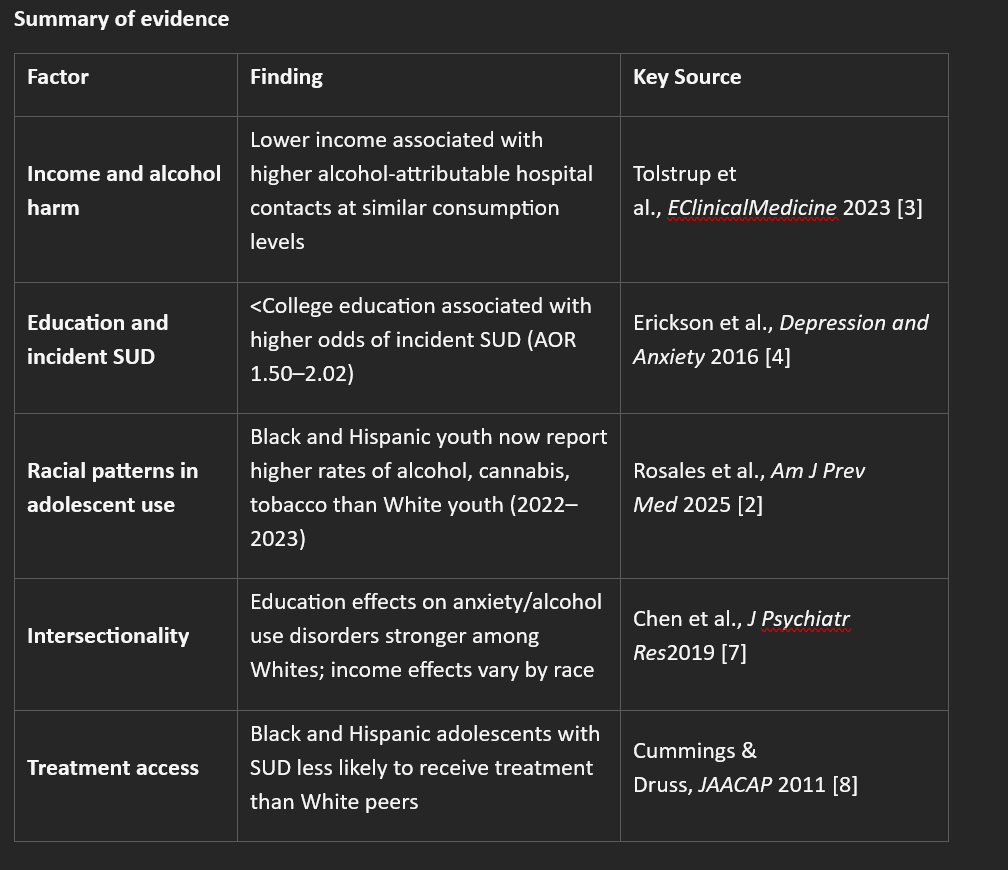
The evidence regarding substance use disorder (SUD) incidence among white, upper-income, educated adolescents is more nuanced than a simple protective effect. While some data suggest lower SUD prevalence in higher socioeconomic strata, recent epidemiologic shifts and intersectional analyses reveal complex patterns where race, income, and education interact in unexpected ways. The 2022 Monitoring the Future data and 2021 National Survey on Drug Use and Health indicate that Black and Hispanic youth now report higher rates of alcohol, cannabis, and tobacco use than White youth—a reversal from prior decades—challenging assumptions about racial disparities in adolescent substance use [1] [2].
Socioeconomic status and SUD risk
Traditional epidemiologic studies have demonstrated inverse associations between socioeconomic position (SEP) and alcohol-related harm across the lifespan. A prospective cohort study of 68,299 Danish adolescents found that low SEP (measured by parent education, family income, and perceived financial strain) was associated with higher incidence rate ratios for alcohol-attributable hospital contacts (IRR 1.73 for elementary school vs. longer parent education; IRR 1.57 for family financial strain), even after adjusting for weekly alcohol intake, drinking pattern, and substance use [3]. This “alcohol harm paradox”—where similar consumption levels produce greater harm in disadvantaged groups—suggests that socioeconomic factors influence consequences of use more than initiation rates.
However, the relationship between education specifically and SUD appears bidirectional. Longitudinal data from the National Epidemiologic Survey on Alcohol and Related Conditions found that individuals with less than college education at Wave 1 had significantly higher odds of incident substance use disorder at Wave 2 (AOR 1.50–2.02), even after controlling for sociodemographics and psychiatric comorbidity [4]. Conversely, genetic studies indicate that higher educational attainment polygenic scores are associated with lower risk of smoking initiation, fewer cigarettes smoked, and higher likelihood of quitting—effects not mediated by cognitive ability [5].
Racial and ethnic patterns in adolescent substance use
The 2026 JAACAP clinical practice guideline synthesizes recent survey data showing that among 12th grade students, White students used certain specific substances more frequently than other groups, but Black 12th grade students had higher rates of alcohol use (including binge drinking) and tobacco use (including vaping) than other racial/ethnic groups, with overall substance use by Black students higher in 2022 than in prior survey years [1]. The 2021 Youth Risk Behavior Survey reported lower lifetime use of several drugs among Asian and Black high school students compared with nearly every other racial/ethnic group, but increases in past 30-day alcohol drinking and cannabis use across groups [1].
These findings align with a 2025 American Journal of Preventive Medicine analysis noting that Black and Hispanic youth in the 2022–2023 Monitoring the Future studies reported higher likelihood of using most substances than White youth, representing a reversal from years prior to 2022 [2]. The 2023–2024 National Youth Tobacco Survey similarly found higher prevalence of tobacco use among youth of color than among White youth [2].
Intersectionality: when race, income, and education converge
The “Black-White mental health paradox” extends to substance use disorders in some but not all contexts. A 2022 analysis of NCS-R and NSAL data found that the Black-White paradox generally extends across lifetime mood, anxiety, and substance use disorders and is consistent across age and gender groups, with one exception: middle-aged (45–64 years) Black men had higher odds of lifetime substance use disorder relative to their White male middle-aged peers—a difference that became non-significant after accounting for education and employment [6].
Critically, socioeconomic factors may operate differently across racial groups. A 2019 study of individual-level and area-based socioeconomic status found that education had stronger associations with 12-month anxiety and alcohol use disorders among Whites than among other racial/ethnic groups, and that low income compared to high income was associated with lower risk of anxiety disorders among Asians [7]. Among Blacks, subjective socioeconomic status was not associated with any 12-month mental disorders, suggesting that traditional SES measures may not capture the same constructs across racial groups [7].
Treatment access and diagnostic bias
Even when SUD prevalence is lower in certain groups, treatment access disparities persist. A nationally representative analysis of 2001–2008 NSDUH data found that Black and Hispanic adolescents with SUD were significantly less likely than White adolescents to receive SUD treatment (Black RD −3.9%, 95% CI −6.4% to −1.3%; Hispanic RD −2.3%, 95% CI −4.1% to −0.4%), with differences exacerbated after adjustment for family income and health insurance [8]. This suggests that observed prevalence differences may partially reflect underdetection or underdiagnosis in minoritized populations rather than true lower incidence [9].
Clinical implications
For pediatric anesthesiologists and pain medicine specialists, these data suggest that socioeconomic and racial assumptions about SUD risk may be outdated. The 2022 AAP policy statement emphasizes that “differences in exposure to social-environmental risk and protective factors contribute to disparities in rates of substance use between groups” and that youth with intersectional identities have higher risk of developing substance use-related problems [10]. Screening and perioperative risk assessment should not rely on demographic proxies alone but should incorporate individual-level factors including adverse childhood experiences, mental health comorbidities, and substance use patterns [10].
References
Clinical practice guideline: assessment and treatment of adolescents and young adults with substance use disorders and problematic substance use (excluding tobacco). Journal of the American Academy of Child and Adolescent Psychiatry, 2026
Ethnic discrimination’s role on increased substance susceptibility and use among U.S. youth. American Journal of Preventive Medicine, 2025
Socioeconomic inequalities in alcohol-related harm in adolescents: a prospective cohort study of 68, 299 Danish 15-19-year-olds. EClinicalMedicine, 2023
Educational attainment as a protective factor for psychiatric disorders: findings from a nationally representative longitudinal study. Depression and Anxiety, 2016
Exploring the genetic overlap between substance use disorder and educational attainment. Addiction, 2026
Is the black-white mental health paradox consistent across age, gender, and psychiatric disorders?. Aging & Mental Health, 2022
Racial and ethnic differences in individual-level and area-based socioeconomic status and 12-month DSM-IV mental disorders. Journal of Psychiatric Research, 2019
Racial / ethnic differences in treatment for substance use disorders among U.S. adolescents. Journal of the American Academy of Child and Adolescent Psychiatry, 2011
Unpacking the layers: dismantling inequities in substance use services and outcomes for racially minoritized adolescents. Child and Adolescent Psychiatric Clinics of North America, 2022
Improving substance use prevention, assessment, and treatment financing to enhance equity and improve outcomes among children, adolescents, and young adults. Pediatrics, 2022
Chinwe Ajuba-Iwuji MD responds
I appreciate the response and will certainly look more in-depth at the articles you cited but did read through your response. I too did a brief search after reading the troubling statement/assessment in PAAD and my general sense was that adolescents who are white and of higher socioeconomic status are less likely to admit use but you could also find data that there is a substance use epidemic amongst this population. This data is so heterogeneous and too complex to lump into a single summary statement as we saw in PAAD. If this statement was a summary of the authors opinions, there should have been consideration of either omission or providing further clarity on where the data stands (which is everywhere). Depending on the study you review, you get a different answer. Also, tobacco and alcohol use, is different from marijuana, narcotics, meth, etc so lumping it all as SUD seems unusual.
In general, I wish you, and the authors exercised greater caution in replicating such a jarring summary statement especially given the polarizing times. The discussion is nuanced with too many different variables; a single summary statement doesn’t do this justice. As a Nigerian American, it was off-putting, offensive, and incongruent with my clinical experience (although I am just one individual). My current hospital resides in a largely African American community with a big referral base so a demographic mix for sure. I was previously at Hopkins with a similar population. If trainees read this, they may not have enough clinical or personal experience to question it. As demonstrated below in your citations, the data is far from concrete and replicating such a statement would have given me pause..