
Substance Use Before Surgery? Does it really impact postoperative pain?
Rita Agarwal MD FAAP, FASA and Amber Borucki MD

Original article
Groenewald CB, Rabbitts JA, Borucki AN, Agarwal R, Sabatti C, Palermo TM, Rogers AH. Association Between High-Risk Preexisting Substance Use and Increased Postoperative Opioid Dose Use Among Adolescents Undergoing Ambulatory Orthopedic Surgery. Paediatr Anaesth. 2026 Jul;36(7):832-840. doi: 10.1002/pan.70190. Epub 2026 Apr 22. PMID: 42017944.
When you’re doing your preoperative assessment on a 16-year-old coming in for an ACL repair, do you ask about substance use? We have written previous PAADs on the importance of asking patients anonymously about substance use before anesthesia, Substance Use Preoperative Screening and today’s PAAD by Groenewald et al.(1) helps validate this.
Surgery (including dental procedures) is the most common indication for opioid prescriptions in adolescents. Almost 2 million adolescents undergo surgery in the USA each year. While the incidence of opioid use may be decreasing, the incidence of opioid related deaths in the adolescent and young adult (AYA) population has remained the same. Several studies have shown that the incidence of subsequent opioid morbidity in patients who receive post-operative opioids increases by 30-40% compared to patients who do not receive opioids (Quinn).(2) This includes opioid prescriptions after dental surgery (Schroeder).(3)
Today’s PAAD is one of the first to examine if a history of ANY substance use prior to surgery is associated with increased pain and use of opioids in the postoperative period.
What They Did
121 healthy ASA 1 or 2 adolescents (ages 11–19, mean 15 years, nearly half female) undergoing elective sports-injury related, ambulatory orthopedic surgery, who had not previously been prescribed opioids or had a known history of SUD, completed a validated substance use screener called the BSTAD (Brief Screener for Tobacco, Alcohol, and Drugs) before surgery.(4, 5) BSTAD puts patients into one of three buckets: no use, low-risk use, or high-risk use, based on what they’ve used and how often in the past year. All patients underwent anesthesia with general and regional anesthesia, in addition to a standard postoperative analgesic protocol that included around-the-clock acetaminophen and NSAIDs.
Everyone was prescribed immediate-release oxycodone for 12–18 doses postoperatively, and opioid use was measured objectively using an electronic pill cap (eCAP) that passively recorded every time the bottle was opened. Pain scores were captured 4 times a day via a smartphone diary for 14 days.
What They Found
First, a reality check: only 10.7% of this cohort (13 patients) were identified as high risk. That’s well below national estimates — the 2023 National Survey on Drug Use and Health puts alcohol use among 12–17 year olds at roughly 1 in 4, and marijuana use at nearly 1 in 5.(6) Our previous PAAD on anonymous pre-operative screening found similar rates with alcohol and marijuana use being reported at ~ 28 % and 21% of adolescents completing the survey.(7) The authors think the low rate reflects several factors: younger patients, a predominantly white, high-income cohort, and the possibility that some teens may have had concerns about confidentiality.
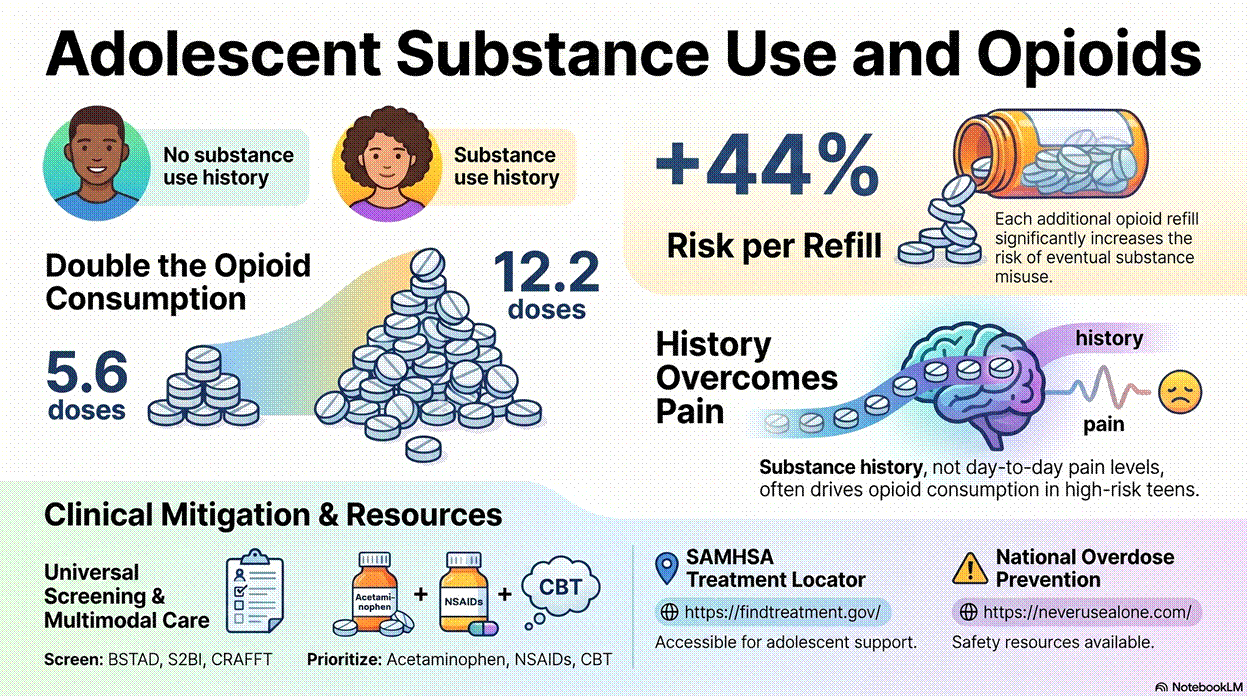
Nevertheless, the findings are important: kids who screened high-risk for substance use took twice as many opioid doses in the two weeks after surgery compared to those with no use — 12.2 doses versus 5.6. Even after controlling for sex, depression, anxiety, surgery type, and postoperative pain intensity, the association held: an incidence rate ratio of 1.96 (95% CI). Nearly a two-fold difference.
Teens that were screened with low SUD risk, opioid use tracked directly with pain scores— more pain = more opioids; less pain = fewer opioids.
In the high-risk group, the pattern was different. Their substance use history — not the day-to-day swings in pain intensity — correlated more closely with daily opioid consumption. Put simply, they were more likely to reach for the opioids even with lower pain scores. The interaction fell short of significance, but this may be important to investigate in future studies.
This Fits With What We Already Know
The finding that substance use predicts higher postoperative opioid consumption isn’t entirely surprising — there’s a body of literature in adults pointing in the same direction, and this study adds prospective, objective data in a pediatric population that has been missing.
The most comprehensive adult data comes from Lawal and colleagues’ 2020 systematic review and meta-analysis in JAMA Network Open, which pooled 33 studies and nearly 1.9 million patients and found that preoperative alcohol use, tobacco use, and marijuana use were all associated with an increased risk of prolonged opioid use after surgery.(8) The Groenewald study both confirms this in adolescents and improves on the methodology — objective opioid measurement during the immediate postoperative period, rather than insurance claims data months later.
Cannabis specifically has been getting increasing attention. A retrospective study of adults undergoing anterior cervical decompression and fusion found that patients who actively used cannabis had average daily opioid use of 49.4 morphine milligram equivalents (MME) at 6–12 months postoperatively, compared to 13.3 MME in patients who did not use cannabis— and a reoperation rate of 23.1% versus 4%.(9) The ASRA Pain Medicine consensus guidelines, released in 2023 — the first U.S.-based perioperative cannabis guidelines — now recommend universal screening for cannabis use before surgery specifically because of this evidence of higher postoperative pain and opioid requirements.(10)
There is little pediatric data. A 2024 study in the Journal of the American College of Surgeons found that cannabis use disorder (CUD) is increasing among adolescents scheduled for inpatient surgery — from 0.4% in 2009 to 0.6% in 2022 — and was associated with worse postoperative outcomes.(11) The Adolescent Surgery Experience (ASE) cohort study found that one in six adolescents undergoing surgery endorsed past-year substance use, and identified substance use disorders as one of several risk factors for persistent postoperative opioid use in this age group.(11)
Worth noting: persistent opioid use after pediatric surgery is not rare. Sun et.al estimated that 3–4.8% of previously opioid-naïve adolescents who undergo surgery develop persistent opioid use after surgery.(12) Brat et al.(13) found that each refill and week of opioid prescription is associated with an increase in opioid misuse among opioid naive patients. The misuse rate almost doubled among those with one refill compared with those with none. In total, each additional refill increased the rate of misuse by 70.7% after adjusting for covariates. The data from this study suggests that duration of the prescription rather than dosage is more strongly associated with ultimate misuse in the early postsurgical period
Why Does this Matter?
“Legitimate opioid use before high school graduation is independently associated with a 33% increase in the risk of future opioid misuse after high school. This association is concentrated among individuals who have little to no history of drug use and, as well, strong disapproval of illegal drug use at baseline.”(14)
The authors recommend routine preoperative substance use screening using any of the validated tools — BSTAD, S2BI, or CRAFFT — and are careful to frame this as a way to personalize care, not a reason to under-treat pain. The BSTAD and S2BI can each be completed in under two minutes and are freely available through the National Institute on Drug Abuse (links: BSTAD, S2BI)
For teens who screen positive: Set realistic pain expectations, maximize multimodal non-opioid analgesia, consider incorporating cognitive-behavioral strategies and a mental health professional when appropriate, and offer support and connect the patient to resources for treatment
Another PAAD on Perioperative Considerations in Adolescents and Young Adults with SUD by Kitzman et. al on caring for AYA with SUD has additional recommendations and resources for care of these patients.
Limitations
This was a small sample, a single site and a mostly white and higher-income demographic. There were only 13 patients in the high-risk category, limiting statistical power. The eCAP measures bottle openings, not number of pills consumed with each bottle opening. Baseline preoperative pain wasn’t collected. And roughly 21% of participants used zero opioids — a reminder that for a significant number of kids having these procedures, non-opioid analgesia gets the job done just fine.
Bottom Line
High-risk use of ANY substance prior to surgery can increase the use of opioids in adolescents in the postoperative period. If your facility is not asking about substance use preoperatively, it should consider starting.
Send your thoughts and comments to Myron (myasterster@gmail.com) and he will post in a Friday reader response.
References
1. Groenewald CB, Rabbitts JA, Borucki AN, Agarwal R, Sabatti C, Palermo TM, et al. Association Between High-Risk Preexisting Substance Use and Increased Postoperative Opioid Dose Use Among Adolescents Undergoing Ambulatory Orthopedic Surgery. Paediatric anaesthesia. 2026;36(7):832–40. Epub 20260422. doi: 10.1002/pan.70190. PubMed PMID: 42017944.
2. Quinn PD, Fine KL, Rickert ME, Sujan AC, Boersma K, Chang Z, et al. Association of Opioid Prescription Initiation During Adolescence and Young Adulthood With Subsequent Substance-Related Morbidity. JAMA pediatrics. 2020;174(11):1048–55. doi: 10.1001/jamapediatrics.2020.2539. PubMed PMID: 32797146; PubMed Central PMCID: PMC7418042.
3. Schroeder AR, Dehghan M, Newman TB, Bentley JP, Park KT. Association of Opioid Prescriptions From Dental Clinicians for US Adolescents and Young Adults With Subsequent Opioid Use and Abuse. JAMA internal medicine. 2019;179(2):145–52. doi: 10.1001/jamainternmed.2018.5419. PubMed PMID: 30508022; PubMed Central PMCID: PMC6439650.
4. Kelly SM, Gryczynski J, Mitchell SG, Kirk A, O’Grady KE, Schwartz RP. Validity of brief screening instrument for adolescent tobacco, alcohol, and drug use. Pediatrics. 2014;133(5):819–26. doi: 10.1542/peds.2013-2346. PubMed PMID: 24753528; PubMed Central PMCID: PMC4006430.
5. Levy S, Weiss R, Sherritt L, Ziemnik R, Spalding A, Van Hook S, et al. An electronic screen for triaging adolescent substance use by risk levels. JAMA pediatrics. 2014;168(9):822–8. doi: 10.1001/jamapediatrics.2014.774. PubMed PMID: 25070067; PubMed Central PMCID: PMC4270364.
6. Kitzman JM, Mesheriakova VV, Borucki AN, Agarwal R. Substance Use Disorders in Adolescents and Young Adults: History and Perioperative Considerations From the Society for Pediatric Pain Medicine. Anesthesia and analgesia. 2023. Epub 20230714. doi: 10.1213/ane.0000000000006623. PubMed PMID: 37450650.
7. Stone K, Rice-Weimer J, Tram NK, Tobias JD. Efficacy of an expanded preoperative survey during perioperative care to identify illicit substance use in teenagers and adolescents. Paediatric anaesthesia. 2023;33(10):808–15. Epub 20230712. doi: 10.1111/pan.14728. PubMed PMID: 37435702.
8. Lawal OD, Gold J, Murthy A, Ruchi R, Bavry E, Hume AL, et al. Rate and Risk Factors Associated With Prolonged Opioid Use After Surgery: A Systematic Review and Meta-analysis. JAMA network open. 2020;3(6):e207367. Epub 20200601. doi: 10.1001/jamanetworkopen.2020.7367. PubMed PMID: 32584407; PubMed Central PMCID: PMC7317603.
9. Razzouk J, Chung JH, Lindsey W, Ramos O, Cheng W, Danisa O. Preoperative Cannabis Use Associated With an Increased Rate of Reoperation and Postoperative Opioid Use Following Anterior Cervical Decompression and Fusion. Cureus. 2022;14(11):e31285. Epub 20221109. doi: 10.7759/cureus.31285. PubMed PMID: 36514630; PubMed Central PMCID: PMC9733193.
10. Shah S, Schwenk ES, Narouze S. ASRA Pain Medicine consensus guidelines on the management of the perioperative patient on cannabis and cannabinoids: an infographic. Regional anesthesia and pain medicine. 2023;48(3):119. Epub 20230103. doi: 10.1136/rapm-2022-104193. PubMed PMID: 36596581.
11. Willer BL, Mpody C, Nafiu OO. Trends in Adolescent Comorbid Cannabis Use Disorder and Postoperative Complications. Pediatrics. 2024;153(6). doi: 10.1542/peds.2024-065757. PubMed PMID: 38708543.
12. Sun N, Chowdhury AR, Wu A, Englesakis M, Rosenbloom BN, Steinberg BE, et al. Prolonged opioid use after surgery in children, adolescents, and young adults: a systematic review. Canadian journal of anaesthesia = Journal canadien d’anesthesie. 2025;72(4):579–90. Epub 20250324. doi: 10.1007/s12630-025-02921-7. PubMed PMID: 40126793.
13. Brat GA, Agniel D, Beam A, Yorkgitis B, Bicket M, Homer M, et al. Postsurgical prescriptions for opioid naive patients and association with overdose and misuse: retrospective cohort study. BMJ (Clinical research ed). 2018;360:j5790. Epub 20180117. doi: 10.1136/bmj.j5790. PubMed PMID: 29343479; PubMed Central PMCID: PMC5769574.
14. Miech R, Johnston L, O’Malley PM, Keyes KM, Heard K. Prescription Opioids in Adolescence and Future Opioid Misuse. Pediatrics. 2015;136(5):e1169–77. doi: 10.1542/peds.2015-1364. PubMed PMID: 26504126; PubMed Central PMCID: PMC4834210.
Very valuable information.