
Supporting Safer Surgery: System-Level Interventions to Enhance Pediatric Perioperative Safety
Myron Yaster MD, Melissa Brooks Peterson MD, Lynn Martin MD, Randall Flick MD, Sapna Kudchadkar MD, Joseph P. Cravero, MD, FAAP, and Timothy W. Martin, MD, MBA, FSA

In today’s PAAD, Natarus et al.(1) report a successful quality improvement initiative which demonstrated that implementation of high reliability organization (HRO) principles substantially reduced serious perioperative safety events. The initiative was performed in a large, 364-bed academic pediatric center, performing more than 23,000 operations annually (Ann & Robert H. Lurie Children’s Hospital of Chicago). It was triggered by a cluster of 13 (14 in the table) serious safety events (SSEs) and Joint Commission sentinel events over a 21-month period. The initiative sought to transform perioperative safety culture through coordinated, system-level interventions rather than isolated corrective actions.
This is a pretty astonishing article and the authors have to be applauded for disclosing their “dirty laundry” in such a public fashion. In order to elicit the changes they desired, the institution had to essentially tear down their walls to the studs to fix it.
Before we begin our PAAD review, some basic definitions are needed (from AI NEJM OpenEvidence):
High reliability organizations (HROs) in healthcare are organizations that operate in complex, high-risk environments yet maintain extremely low rates of harm or error through a distinctive set of organizational principles and cultural commitments.(2, 3)
Five Core Principles of HROs
HROs emphasize system-level failures rather than blaming individuals, while still holding all members accountable for continuous improvement.(4)
A strong culture of psychological safety is essential — staff must feel empowered to speak up and report concerns without fear of retaliation.(2, 4)
Teamwork and interdisciplinary communication are foundational; the Institute of Medicine (IOM) and the Agency for Healthcare and Quality (AHRQ) have promoted programs like TeamSTEPPS to enhance team performance in healthcare.(5)
Research suggests that HRO-inspired programs may be more readily adopted by some professional groups (e.g., nursing) than others, and that principles like “deference to expertise” and “commitment to resilience” can be harder to operationalize than “preoccupation with failure”. (6)
Reducing irrational variation through standardized clinical practices is a key mechanism by which HROs decrease complexity and risk.
Serious safety events (SSEs) in healthcare are safety events that reach the patient and result in moderate to severe harm or death.(7) They represent the most critical category in the safety event classification scheme.
A Joint Commission sentinel event is defined as a safety event — not primarily related to the natural course of a patient’s illness or underlying condition — that reaches a patient and results in death, severe harm (regardless of duration), or permanent harm (regardless of severity). The term “sentinel” signals the need for immediate investigation and response.(8) Some sentinel events include: Unanticipated death of a full-term infant, Homicide of any patient, staff member, visitor, or vendor while on site or under the organization’s care, Any intrapartum maternal death, Sexual abuse/assault of any patient, staff member, visitor, or vendor on site or under the organization’s supervision; Physical assault leading to death, permanent harm, or severe harm (patients, staff, visitors, or vendors), Wrong-site, wrong-patient, or wrong-procedure surgery — regardless of procedure type or magnitude of outcome; Discharge of an infant to the wrong family; Abduction of any patient, Incompatible blood/blood product administration (ABO and non-ABO incompatibilities), hemolytic transfusion reactions, or transfusions resulting in death/permanent/severe harm, and Unintentionally retained foreign objects (URFOs)
I’ve asked members of the Pediatric Anesthesia Leadership Council (PALC) to help write today’s PAAD and to add their own personal and institutional experiences which will appear in an accompanying PAAD.
Original article
Natarus ME, Naureckas Li C, Studer A, Shaw A, Raval MV, Dsida RM, Olmstead J, Pytel C, Stuart H, Inge TH, Schroeder S, Wheeler DS. Supporting Safer Surgery: System-Level Interventions to Enhance Pediatric Perioperative Safety. Pediatrics. 2026 Jul 1;158(1):e2025072662. doi: 10.1542/peds.2025-072662. PMID: 42270089.
Medical errors directly impact patient clinical outcomes and result in substantial financial implications for both patients and hospital systems. Triggered by a cluster of 13 serious safety events (SSEs) and Joint Commission sentinel events over a 21-month period, the initiative sought to transform perioperative safety culture through coordinated, system-level interventions rather than isolated corrective actions. Review of adverse events identified recurring system failures involving communication breakdowns, inconsistent leadership responses, retained foreign bodies, wrong-site or wrong-procedure events, incorrect line placement, operating room fires, and workflow deficiencies. Root cause analyses demonstrated that sustainable improvement required organizational changes addressing leadership, communication, psychological safety, and frontline engagement rather than focusing solely on individual events. A key driver diagram (below) identified three essential domains for improvement: leadership, culture of safety, and data systems.
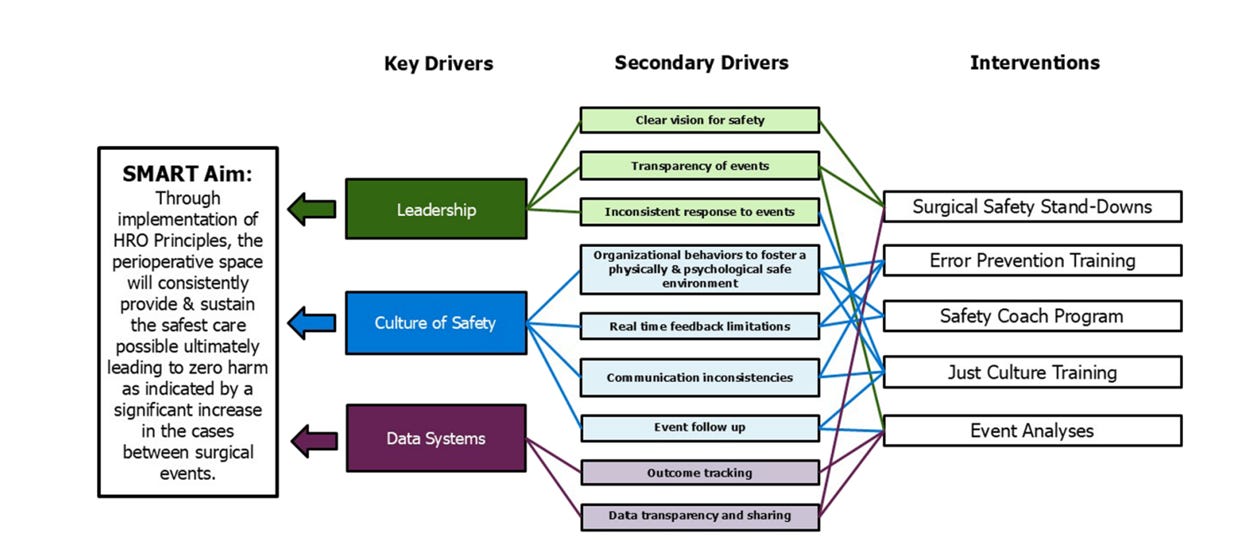
Three complementary interventions were introduced over six months.
The first was the implementation of perioperative surgical safety stand-downs, modeled after military safety practices. Elective surgical activity was temporarily paused to allow multidisciplinary participation in institution-wide discussions of patient safety. Executive leaders transparently reviewed recent safety events, organizational performance metrics, and expectations for improvement. Importantly, patients’ family members described the personal consequences of medical errors, reinforcing the importance of patient-centered care and shared accountability
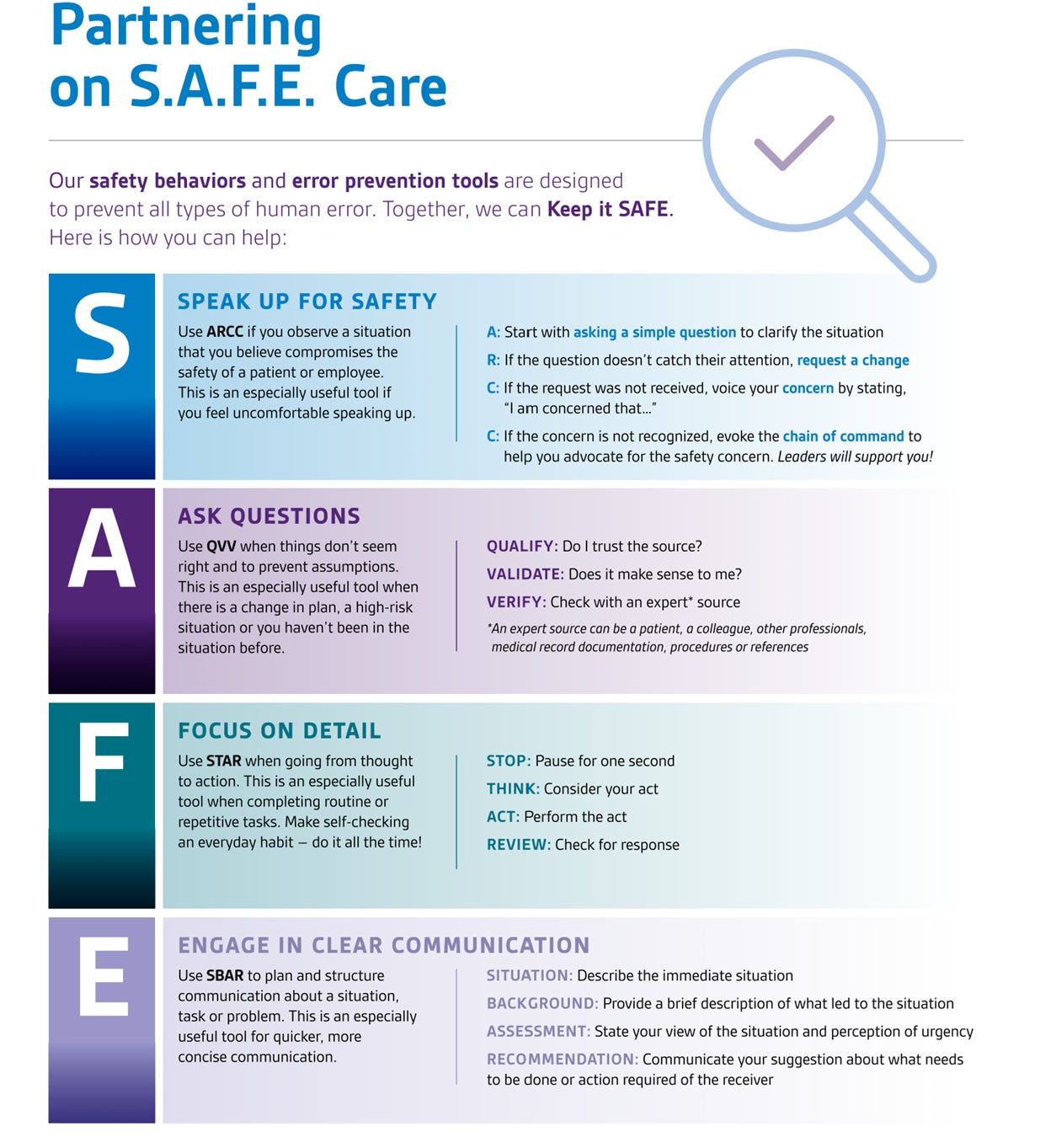
The second intervention focused on error prevention training using standardized HRO communication tools summarized in the “Partnering on S-A-F-E Care“ toolkit (Figure 2 from the article below). Four evidence-based safety behaviors were emphasized:
ARCC (Ask a question, Request a change, voice a Concern, use the Chain of command) to encourage speaking up for safety.
QVV (Qualify, Validate, Verify) to improve critical thinking and questioning.
STAR (Stop, Think, Act, Review) to enhance attention during high-risk tasks.
SBAR (Situation, Background, Assessment, Recommendation) to standardize clinical communication.
These tools were reinforced through mandatory education modules, badge cards, digital signage, departmental meetings, and daily operational safety briefings. Leadership simultaneously emphasized psychological safety so that staff could raise concerns without fear of blame or retaliation.
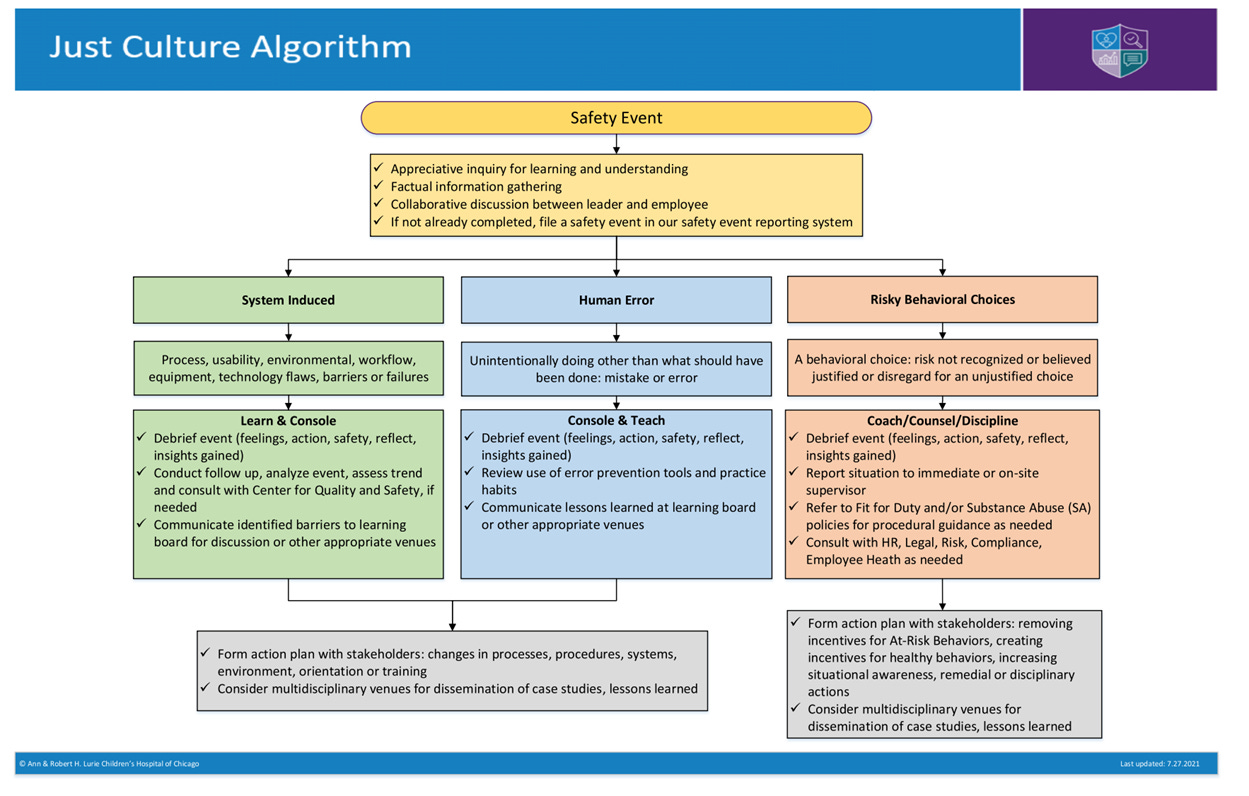
The third intervention established a multidisciplinary safety coach program involving surgeons, anesthesiologists, nurses, and perioperative support personnel. Safety coaches received formal instruction in peer-to-peer coaching, simulation, appreciative inquiry, and real-time feedback techniques. Monthly meetings reinforced safe practices, promoted discussion of emerging safety trends, and encouraged identification of near misses and “good catches.” The program was supported by implementation of a Just Culture framework, providing leaders with a structured algorithm to distinguish system failures, human error, and risky behavior while emphasizing learning rather than punishment.
Ok, what did they find? The interventions produced astonishing improvements. Prior to implementation, an SSE or sentinel event occurred in approximately one of every 2,977 surgical cases (about every 50 days). Following implementation, the institution completed 39,654 consecutive operations over 585 days without another serious safety event. The subsequent two events also occurred well beyond historical expectations, after 13,040 and 14,715 additional surgical cases, respectively. Statistical process control analysis demonstrated sustained special-cause improvement, indicating that these gains were unlikely to represent random variation. Importantly, surgical case volume continued to increase throughout the study period, demonstrating that safety improvements did not adversely affect operating room productivity.
An additional indicator of success was a progressive increase in voluntary safety reporting, suggesting improved psychological safety and greater staff engagement rather than worsening clinical performance. Mandatory safety education achieved an 87% completion rate during the first year, while the safety coach program expanded from 21 participants representing 10 disciplines to 28 participants representing 16 professional roles.
Natarus et al, attribute the success of the initiative to several synergistic factors: strong executive leadership, transparent communication of safety data, standardized HRO communication tools, frontline safety coaching, and consistent application of Just Culture principles. They acknowledge limitations, including the single-center pediatric setting, dependence on strong institutional leadership, and the possibility that voluntary reporting may underestimate adverse events.
We think this study provides compelling evidence that comprehensive implementation of HRO principles can substantially improve pediatric perioperative safety. By integrating leadership engagement, standardized communication strategies, frontline coaching, transparent safety reporting, and a Just Culture framework, healthcare organizations can meaningfully reduce serious patient harm while maintaining clinical productivity. These interventions are practical, scalable, and should be considered integral components of modern pediatric perioperative quality improvement programs.
Send your thoughts and comments to Myron (myasterster@gmail.com) and he will post in a Friday reader response. And note, because of the potential for retribution, all comments on this topic will be posted anonymously.
References
1. Natarus ME, Naureckas Li C, Studer A, Shaw A, Raval MV, Dsida RM, et al. Supporting Safer Surgery: System-Level Interventions to Enhance Pediatric Perioperative Safety. Pediatrics. 2026;158(1). doi: 10.1542/peds.2025-072662. PubMed PMID: 42270089.
2. Gill A, Leiner CD, Steinberg DI. High Reliability in Health Care. The Medical clinics of North America. 2025;109(5):981–96. Epub 20250508. doi: 10.1016/j.mcna.2025.02.002. PubMed PMID: 40752939.
3. Christianson MK, Sutcliffe KM, Miller MA, Iwashyna TJ. Becoming a high reliability organization. Critical care (London, England). 2011;15(6):314. Epub 20111208. doi: 10.1186/cc10360. PubMed PMID: 22188677; PubMed Central PMCID: PMC3388695.
4. Shea KG. Strategies and Tools to Enhance Patient Safety: HROs, HEROs, and Safety Culture. Journal of pediatric orthopedics. 2020;40 Suppl 1:S30–s2. doi: 10.1097/bpo.0000000000001500. PubMed PMID: 32502068.
5. Baker DP, Day R, Salas E. Teamwork as an Essential Component of High-Reliability Organizations. Health services research. 2006;41(4p2):1576–98. doi: https://doi.org/10.1111/j.1475-6773.2006.00566.x.
6. Rotteau L, Goldman J, Shojania KG, Vogus TJ, Christianson M, Baker GR, et al. Striving for high reliability in healthcare: a qualitative study of the implementation of a hospital safety programme. BMJ quality & safety. 2022;31(12):867–77. Epub 20220601. doi: 10.1136/bmjqs-2021-013938. PubMed PMID: 35649697.
7. Marra AR, Algwizani A, Alzunitan M, Brennan TMH, Edmond MB. Descriptive Epidemiology of Safety Events at an Academic Medical Center. Int J Environ Res Public Health. 2020;17(1). Epub 20200104. doi: 10.3390/ijerph17010353. PubMed PMID: 31947963; PubMed Central PMCID: PMC6982027.
8. Division SIRS, Angle JF, Nemcek AA, Jr., Cohen AM, Miller DL, Grassi CJ, et al. Quality Improvement Guidelines for Preventing Wrong Site, Wrong Procedure, and Wrong Person Errors: Application of the Joint Commission “Universal Protocol for Preventing Wrong Site, Wrong Procedure, Wrong Person Surgery” to the Practice of Interventional Radiology. Journal of Vascular and Interventional Radiology. 2008;19(8):1145–51. doi: 10.1016/j.jvir.2008.03.027.
The result that looks like a failure on paper is the one I'd point people to: voluntary reporting went up. That number only moves when staff believe a report will land on a process instead of on a person. Anesthesia has its own version of this in the mid-1980s decision to make pulse oximetry and capnography mandatory in every case — it worked because it removed the judgment call rather than asking people to be more careful. And the ARCC behavior that actually gets tested in my room is unglamorous: someone leaning on an arm that's already positioned, or reaching for the bed remote on a patient who can't object. How that gets received on the third case of the day tells you more about the culture than the stand-down does.