
Remembering the Classics: Lessons from Behavioral Research in Pediatric Anesthesia
Bishr Haydar MD and Myron Yaster MD

Original article
Martin SR, Chorney JM, Tan ET, Fortier MA, Blount RL, Wald SH, Shapiro NL, Strom SL, Patel S, Kain ZN. Changing healthcare providers’ behavior during pediatric inductions with an empirically based intervention. Anesthesiology. 2011 Jul;115(1):18-27. doi: 10.1097/ALN.0b013e3182207bf5. PMID: 21606826; PMCID: PMC3124404.
Original article
Chorney JM, Torrey C, Blount R, McLaren CE, Chen WP, Kain ZN. Healthcare provider and parent behavior and children’s coping and distress at anesthesia induction. Anesthesiology. 2009 Dec;111(6):1290-6. doi: 10.1097/ALN.0b013e3181c14be5. PMID: 19934874; PMCID: PMC2790460.
The impact of clinician-patient interactions is widely recognized, yet often difficult to quantify. Evidence accumulated over decades suggests that an anesthesiologist’s bedside manner can significantly influence patient anxiety, sometimes more effectively than pharmacologic interventions. This concept has been appreciated since the 1960s, when Egbert et al.(1) demonstrated that physician encouragement and communication could reduce postoperative pain and improve patient outcomes. More recently, a curriculum focused on humanism in medicine was shown to improve resident-patient interactions while reducing patient anxiety and postoperative pain.(2)
Children, however, respond to stress differently than adults. Consequently, strategies that alleviate anxiety in pediatric patients often differ from those used in older populations. Two influential studies published by Dr. Zeev Kain’s research group in Anesthesiology by Chorney et al.(3) and Martin et al.(4) provide important insights into how healthcare professionals can reduce perioperative distress in children.
Understanding Effective Behaviors
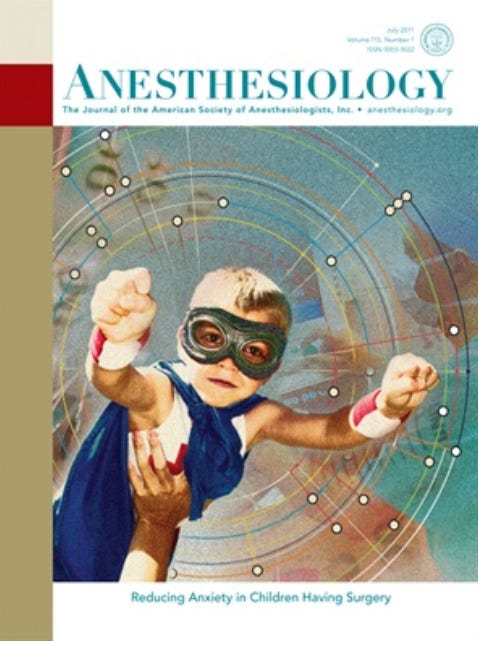
The July 2011 cover article in Anesthesiology demonstrated that healthcare providers can be trained to improve their interactions with pediatric patients. Building upon observations from earlier behavioral research, the investigators developed a brief educational intervention that successfully reduced anxiety during anesthesia induction.
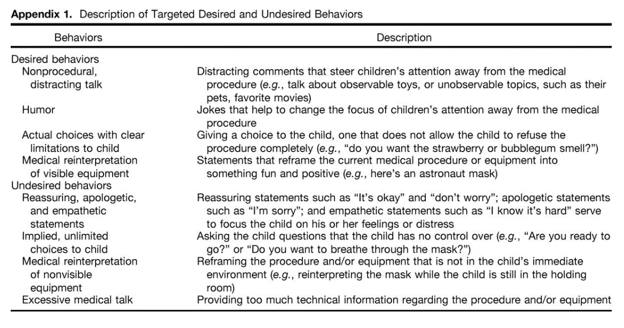
The intervention emphasized several desirable behaviors:
Use of nonprocedural, distracting conversation
Appropriate humor
Offering limited, controlled choices
Positive reinterpretation of visible medical equipment
Examples include discussing a child’s pets or favorite movies, making jokes that redirect attention away from the procedure, offering distinct choices that preserve cooperation (“Would you like the strawberry or bubblegum scent?”), and reframing equipment in child-friendly terms (“Here is your astronaut mask”).
Conversely, several commonly used behaviors were identified as undesirable:
Reassurance such as “It’s okay” or “Don’t worry”
Apologetic statements
Expressions of empathy focused on distress
Giving children choices that falsely imply control over unavoidable procedures (“Are you ready to go?”)
Excessive medical explanations
Reinterpreting equipment before it is physically present and relevant
Although often well-intentioned, these behaviors may inadvertently focus a child’s attention on anxiety and discomfort.
The Foundational 2009 Study
In their 2009 investigation, Chorney, Kain, and colleagues examined 293 anesthesia inductions involving ASA physical status I–II children aged 2–10 years undergoing surgery with a parent present.(3) No premedication was administered. Researchers videotaped inductions and systematically coded the behaviors of anesthesiologists, nurses, parents, and children.
The findings were striking. Younger age and discussions that emphasized a child’s emotional state were associated with increased anxiety and distress. In contrast, anesthesiologists who positively reinterpreted medical equipment—for example, referring to a facemask as a “space mask”—were associated with lower levels of distress.
Interestingly, parental reinterpretation of equipment did not demonstrate the same benefit. The authors speculated that parents may be more likely to employ such strategies when children are already distressed and less receptive to playful distraction. Perhaps the most counterintuitive finding was that reassurance, apologies, empathic statements, and even physical comforting behaviors were associated with greater child distress. This association likely reflects two mechanisms. First, these behaviors often occur in response to preexisting anxiety. Second, they may reinforce the child’s focus on distress rather than redirect attention away from it. Young children frequently respond more favorably to distraction than to repeated assurances that everything is fine when their perception suggests otherwise.
Translating Research into Practice
The subsequent 2011 study translated these observations into a practical educational intervention.(4) Attending anesthesiologists, perioperative nurses, and first-year anesthesia residents participated in a training session lasting less than two hours. The goal was to increase desirable behaviors and decrease undesirable ones during pediatric anesthesia induction.
Nurses were additionally instructed to provide parents with brief guidance regarding effective communication strategies. As in the earlier study, anesthesia inductions were videotaped and analyzed.
The investigators evaluated 72 inductions involving children aged 2–14 years. Thirty-one inductions occurred before the intervention and 41 afterward. None of the children received premedication, and all had one parent present during induction. Following training, attending anesthesiologists demonstrated substantial increases in desirable behaviors and significant reductions in undesirable behaviors. Similar improvements were observed among nursing staff. Although resident anesthesiologists improved to a lesser degree, the overall effect remained positive. Parents, despite receiving only brief instruction, also exhibited measurable improvements in their interactions. Most importantly, children experienced significantly lower anxiety levels. Modified Yale Preoperative Anxiety Scale (mYPAS) scores decreased by approximately 12–14% during transport to the operating room and during anesthesia induction.
Lasting Lessons
These National Institutes of Health–funded investigations required extraordinary effort. The 2009 study alone involved approximately 1,500 hours of behavioral coding to analyze nearly 300 anesthesia inductions. Yet the resulting insights remain highly relevant to contemporary perioperative practice. Several important considerations deserve mention. First, not all meaningful interactions can be captured through behavioral coding. The intent behind a clinician’s actions may influence how they are perceived. For example, holding a child’s hand may communicate comfort, safety, and support, or alternatively may be interpreted as restraint and loss of control. Such nuances are difficult to quantify but likely contribute substantially to the patient experience. Second, Child Life Specialists represent an invaluable resource in many institutions. Their expertise in child development, communication, and coping strategies positions them uniquely to support children throughout the perioperative journey. Their approaches can also provide important lessons for anesthesiologists and perioperative staff seeking to improve interactions with children across developmental stages.
More than a decade after publication, these studies continue to offer practical, evidence-based guidance. Their central message remains simple: small changes in how clinicians communicate with children can meaningfully reduce perioperative anxiety and improve the overall patient experience and are summarized in the table below.(4)
Send your thoughts and comments to Myron (myasterster@gmail.com) and he will post in a Friday reader response.
References
1. Egbert LD, Battit GE, Welch CE, Bartlett MK. Reduction of postoperative pain by encouragement and instruction of patients. A study of doctor-patient rapport. The New England journal of medicine. 1964;270:825–7. doi: 10.1056/nejm196404162701606. PubMed PMID: 14108087.
2. Canales C, Strom S, Anderson CT, Fortier MA, Cannesson M, Rinehart JB, et al. Humanistic medicine in anaesthesiology: development and assessment of a curriculum in humanism for postgraduate anaesthesiology trainees. British journal of anaesthesia. 2019;123(6):887–97. Epub 20191005. doi: 10.1016/j.bja.2019.08.021. PubMed PMID: 31591019; PubMed Central PMCID: PMC6993108.
3. Chorney JM, Torrey C, Blount R, McLaren CE, Chen WP, Kain ZN. Healthcare provider and parent behavior and children’s coping and distress at anesthesia induction. Anesthesiology. 2009;111(6):1290–6. doi: 10.1097/ALN.0b013e3181c14be5. PubMed PMID: 19934874; PubMed Central PMCID: PMC2790460.
4. Martin SR, Chorney JM, Tan ET, Fortier MA, Blount RL, Wald SH, et al. Changing healthcare providers’ behavior during pediatric inductions with an empirically based intervention. Anesthesiology. 2011;115(1):18–27. doi: 10.1097/ALN.0b013e3182207bf5. PubMed PMID: 21606826; PubMed Central PMCID: PMC3124404.