
Reader response and some news you can use
Myron Yaster MD

From Dheeraj Nagpal MD, New York City
I read with interest the recent PAAD on burnout here, I think this all boils down to “Corporate Greed “ and we the spineless dinosaur generation are the enablers. I am so proud of the young generation for not accepting the status quo and trying to make much needed change and not to be abused as cheap labor.
If our corporate owners want they can cut down their profits and have adequate staffing, as there is enough money for it. Also, let’s stop harping about the noble profession as there is nothing noble about healthcare in which we are viewed as providers and patients as are customers. That’s how the general public looks at healthcare conglomerates, short of calling us a mafia.
Let’s stop talking about the sacrifices we have made by working long hours, there is enough research to prove that in those 24 to 30 hours call past 10 hours we were more capable of doing harm to patients and ourselves. If it was for us the late and mid career professionals, nothing will change, let us support the next generation which is smarter, more worldly wise than us.
Go Knicks!
From Alan Jay Schwartz MD MDEd, retired
It is so wonderful that Dr Yaster has such joy from the 2026 NBA champions, the New York Knicks! You are not alone Myron as I have identical joy with the 2026 Stanley Cup champions, the Carolina Hurricanes! Others among us are equally joyous with their respective World Cup Soccer champions!
There is an important common theme message from these sport champions. TEAM is an essential ingredient of champions! This theme applies to our realm. Anesthesiologists, Surgeons, Nurses are THE TEAM in the OR. Anesthesiologists, Intensivists, Nurses are THE TEAM in the ICU.
Growing up I said I wanted to be an independent physician like my Dermatologist Father. Once I entered the anesthesiology I realized that ours is a TEAM SPORT!
https://www.facebook.com/share/r/1B3kfDbKAE/?mibextid=wwXIfr
News you can use
Bishr Haydar MD sent me this article:
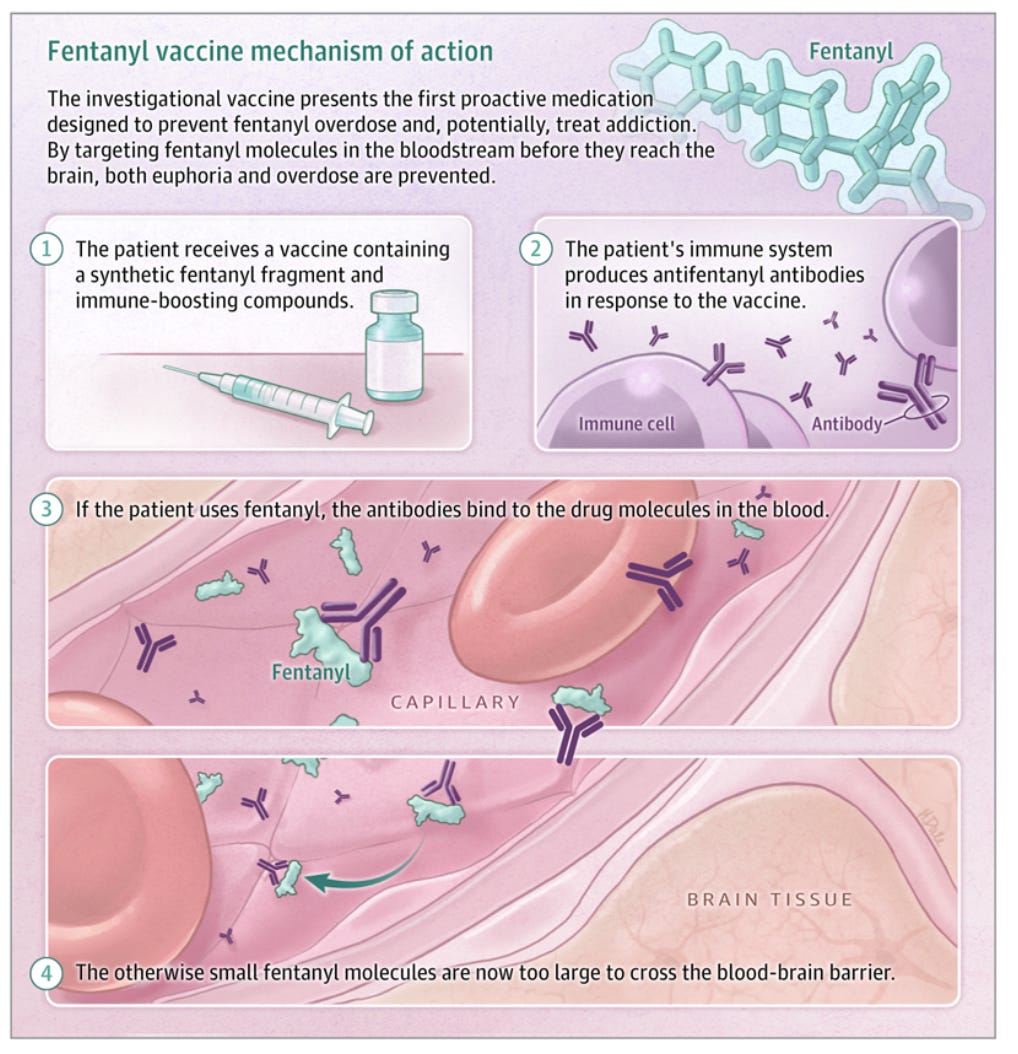
Schweitzer K. Inside the Push for a Fentanyl Vaccine. JAMA. Published online June 12, 2026. doi:10.1001/jama.2026.6392
A first-in-human fentanyl vaccine is entering clinical trials as a novel strategy to prevent overdose and potentially aid treatment of opioid use disorder. Unlike naloxone, the vaccine stimulates production of antifentanyl antibodies that bind the drug in the bloodstream, preventing it from crossing the blood–brain barrier. Early animal studies demonstrated complete blockade of fentanyl’s effects. “
From the article: “So, how do you take a tiny molecule, not a pathogen, and actually make it pretend it’s a piece of a virus or bacteria?” said Seth Toback, MD, MMM, who is leading clinical development of the vaccine as ARMR’s chief medical officer. “What you do is you attach it to a very commonly used larger protein that is big enough to get a response from the immune system.”
The vaccine combines a synthetic fentanyl fragment with established immune-stimulating components and is currently undergoing early phase 1 and 2 testing in healthy volunteers. Potential applications include addiction treatment, protection against accidental exposure, and prevention of overdose from fentanyl-contaminated drugs. Questions remain regarding long-term efficacy, durability of protection, and clinical implementation.
From Scientific American Today in Science <newsletters@scientificamerican.com
U.S. Science in Chaos
Yesterday, I (Andrea Gawrylewski Chief Newsletter Editor) introduced our inaugural class of Young American Scientists and described how that project came into being: the next generation of researchers is facing tumult and uncertainty when it comes to research funding in the U.S. We at Scientific American wanted to spotlight some of the incredible work coming from the scientists of the future. But today I’ll get a little deeper into what is happening to the enterprise of science and why.
History of funding science: Since WWII, the government has had a compact with the scientific enterprise. Officials recognized that science had won the war for the Allies—not only the atomic bomb but also radar, penicillin, food preservation, cryptography, and so on. The state’s capacity to conduct science expanded with the formation of the National Science Foundation and growth of the National Institutes of Health. In the following decades, funding for science evolved further, including investments from venture capitalists. Government-funded research moved into universities, which became partners in discovery. Today, 40 percent of all the funding for basic, blue-sky, exploratory research comes from the federal government. At the same time, the most influential private-sector developers of technology are now in Silicon Valley. Their perspective on innovation is that it should move fast, disrupt markets and make money. That idea is influencing how the government finances science more than ever before.
Current landscape: Under the Trump administration, thousands of federal grants have been frozen or canceled, with around 2,600 still in limbo—about $1.4 billion worth. The NSF and the NIH are awarding three quarters of their usual number of grants. Such cancellations and delayed disbursements are both arbitrary and unprecedented. Many are being justified on the basis of politics—prohibiting, for instance, grants that include language referencing diversity, equity and inclusion (or “woman” or “race”)—which has been unheard of until now. Meanwhile, fewer people are entering graduate programs and nearly 95,000 scientists have left federal government employment. And grant recipients aren’t allowed to share grant money with overseas collaborators, which makes studying diseases like Lassa fever and Ebola next to impossible. Ironically, the current administration has cut millions in funding and yet still wants standout progress in the technology sector.
Missed discovery: In 2025 the NIH cut the amount of grant money awarded by more than 40 percent compared with years prior. What if, one team of economists asked, the NIH research budget had been 40 percent smaller for the past few decades? Grants in the bottom 40 percent of the priority queue, they reasoned, wouldn’t have been funded. The team tracked those grants to their outcomes—research that never happened in this parallel universe—and found that something like half of all drugs simply wouldn’t exist today.
The fallout: How do scientists feel about this chaotic breach of the government-science relationship? “The reality is, because of what happened and what’s happening now, the trust between researchers and the federal government is completely broken,” says Scott Delaney, a former Harvard University epidemiologist who co-created the watchdog group Grant Witness. “Is your grant going to be frozen? Is it going to be terminated? Is it going to be reinstated? Is it going to be delayed because you’re required to change the wording?” Other changes will likely follow, scientists say: “Laboratories are going to close. Trainees are going to go to other countries or pursue nonscience careers,” says Carole LaBonne, a developmental biologist at Northwestern University.