
Reader response and news you can use
Myron Yaster

From Arul Lingappan, M.D. Cook Children’s Medical Center
I am not sure if it would be wise to extrapolate the intranasal (IN) Versed dosing for sedation for a PAINFUL procedure (i.e. laceration repair studied in this article) here to PREOPERATIVE ANXIOLYSIS with IN Versed. Obviously, the latter scenario is most relevant to us as pediatric anesthesiologists. In my clinical experience, IN Versed at the ~0.2-0.3 mg/kg has provided excellent preoperative anxiolysis in the vast majority of 1-4 year olds. Most of these kids actually get closer to the 0.2 mg/kg per our institutional order sets and do quite well. I will compare that to my experience at other institutions, where PO Versed 0.5 mg/kg was the most common premedication. While there may be a setting for being generous with IN Versed (e.g. autistic teenager with an oral aversion), I would NOT advocate for routinely increased IN Versed dosing of 0.4-0.5 mg/kg for preoperative anxiolysis without further study of anesthesia specific outcomes, i.e. adequacy of anxiolysis/premedication versus any unintended consequences of higher doses (e.g. increased emergence delirium, postop PACU duration of stay, perioperative respiratory adverse events, etc.).
From Dr. David Mandelbaum, pediatric neurologist Brown University
This article on intranasal midazolam is a very valuable study for the neurology community as well. The “recommended” dose for intranasal valium is 0.2 mg/kg but I have always dosed it at 0.5 mg/kg (before it was a commercial product this was accomplished with a vial of IV valium drawn into a TB syringe and AFTER THE NEEDLE WAS REMOVED given rectally or intranasally; have to emphasize the removing the needle part; this is still a very cheap and viable way to use valium in ERs to break seizures).
The dose of intranasal midazolam for seizure control is also recommended at 0.2 mg/kg. I use this less often for seizure control but this study suggests that that, too, would best be dosed at 0.5 mg/kg
From Jeff Feldman MD, retired
I am writing in response to the PAAD on Molding the Anesthesiologist’s Persona here. There is no question that the intern year is a challenging time. The sense of responsibility to patients and learning at a time when skills and knowledge are still nascent is daunting. For most trainees, they have also moved geographically, often far from friends and family, and are now working in a new and unfamiliar system. While I agree with the value of a sense of community and connection, I would offer a different perspective on the importance of time spent specifically on Anesthesiology during that year.
Interns who will become Anesthesiologists will have three years of concentrated training in Anesthesiology followed by a career in the specialty. The intern year is the opportunity not just to become a physician as Dr. Lockman observed, but a chance to learn from the various colleagues in other specialties who will participate in the care of our patients in the future. Personally, my intern year was spent in an internal medicine program with rotations in various medical specialties and ICUs and, at that time, on call every third night. While I had no interest in a career in internal medicine, when I entered Anesthesiology, I felt the knowledge gained in internship broadened my perspective, not only about medicine, but how other colleagues involved with my patients contributed to their care. When I look back on my training, the intern year specifically spent not learning Anesthesiology, or connected to that department, enhanced my education and gave me skills that improved my ability to care for patients as an Anesthesiologist.
The work by Cornier et al does a nice job of refining our understanding of the challenges facing interns. This is an intrinsically challenging year and while support is warranted, interns should be encouraged to embrace every experience they can before focusing on a lifetime of practice in Anesthesiology.
Sent from Mark Schreiner MD, retired Reposted from Jono Hey from Sketchplanations <sketchplanations@substack.com>
Legendary basketball coach John Wooden won 10 national championships in 12 years with the UCLA men’s team—a record yet to be bettered. His thoughts on coaching still provide insights and wisdom across all sports and teaching generally. He was a big advocate for preparation, dedication in practice, and repetition so that a player could perform instinctively when it counted. To achieve this, he created eight laws of learning:
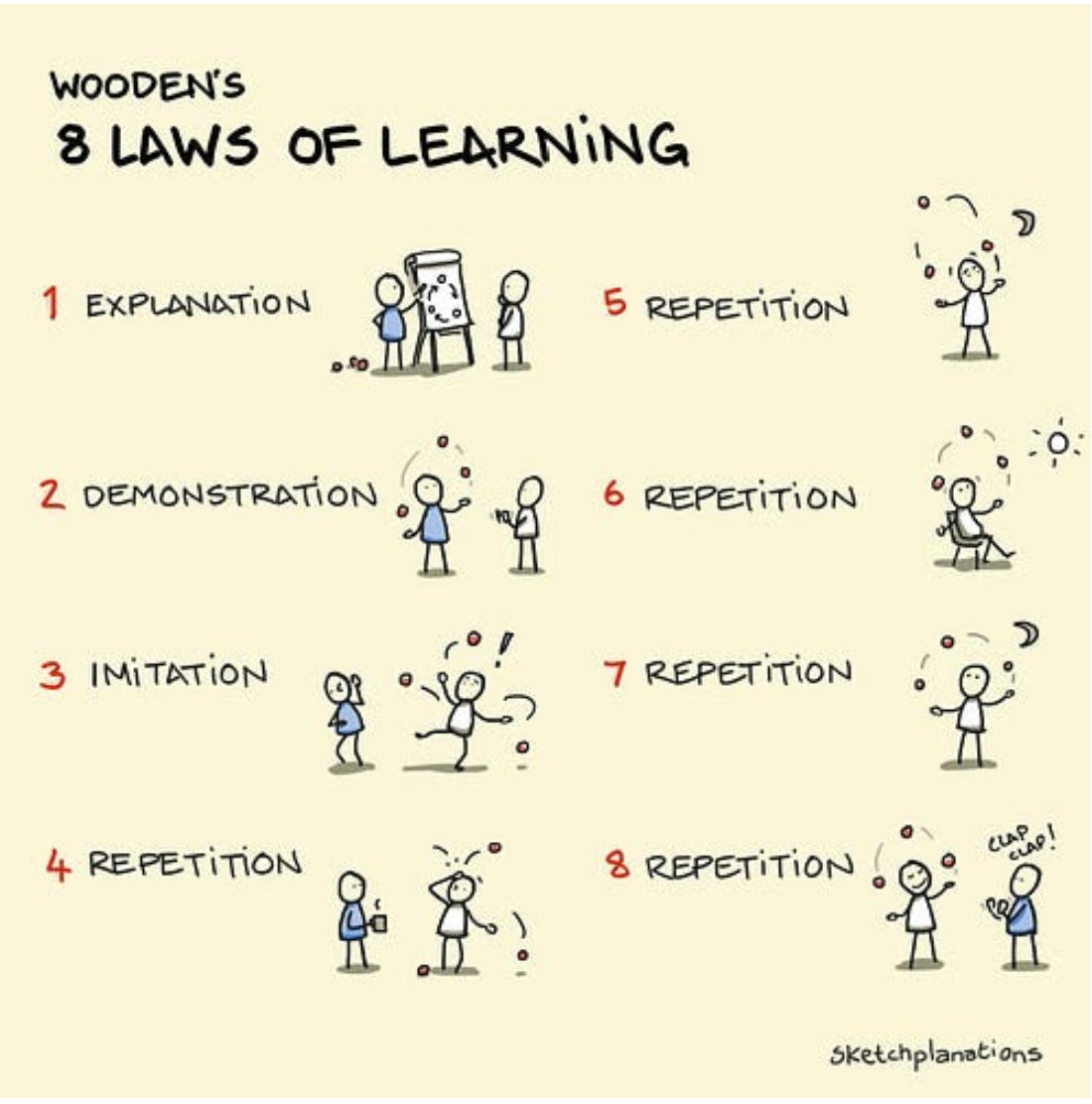
I’ve unknowingly followed John Wooden’s “laws” in sports and music—piano practice. Perhaps you have, too. Whether it’s writing, teaching, coding, drawing, or playing an instrument, Wooden reminds us that unconscious competence comes after repetition, not just once you’ve figured something out.
Sport is not the same as many of the environments we encounter in our lives. Patterns repeat over and over, and feedback is generally accurate and rapid. It can often be what’s called a “kind learning environment”—where experience leads to predictable improvement. Nevertheless, I’d hazard that running through all of Wooden’s 8 Laws to develop skills in most domains we work in is likely to be a good start. Replicate then innovate.
From Lena S. Sun, MD, Professor of Anesthesiology and Pediatrics, Columbia University Irving Medical Center, New York, NY
The Office of Management and Budget (OMB) has proposed sweeping regulatory updates to the Uniform Guidance framework that will significantly alter our NIH grants and daily lab operations. The 45-day public comment window closes on July 13, 2026. These rules take effect on October 1, 2026.
Please take a few minutes to submit your comment.
How to Submit Your Comment
Official Link: Click here to open the Regulations.gov Docket (OMB-2026-0034) and click the blue“Comment” button.
Important Rule: OMB requires you to tag your feedback by placing the specific rule section number in brackets at the very beginning of your text field (e.g., [200.205]). Unique, personalized comments describing your specific research impacts carry the most legal weight.
Key Changes & Section Tags for Your Comments
Peer Review Changes
[200.205]
The Change: Demotes scientific peer review to a purely advisory role, granting political appointees final funding authority.
Impact to Highlight: This undermines merit-based fairness, devalues our service on review panels, and introduces political volatility into steady scientific advancement.
Publication & Conference Cost Restrictions
[200.461]
The Change: Bars the use of federal direct or indirect funds for open-access journal publication fees (APCs) and general conference travel unless pre-approved in writing.
Impact to Highlight: This directly restricts open science, cuts off vital networking and career advancement for our graduate students and postdocs, and creates massive pre-approval administrative bottlenecks.
Drawdown Justifications
[200.305]
The Change: Mandates strict, line-item justification and receipts for drawing down awarded funds.
Impact to Highlight: This will freeze daily lab purchasing, cause immediate cash-flow disruptions for time-sensitive experiments, and shift crushing micro-level clerical burdens onto PIs and lab managers.