
Reader response and news you can use
Myron Yaster MD

From Myron: The growing trend of vaccine hesitancy and science denial by the public and current leaders of the U.S. government is both astonishing and horrifying. Just when I think it cant get worse, this morning while scanning articles for the PAAD, I read the following research letter in JAMA
Scott K, Miller E, Culhane JF, Greenspan J, Handley SC, Lo JY, Knake LA, McKenney KM, Burris HH, Dysart K. Trends in Vitamin K Administration Among Infants. JAMA. 2025 Dec 8:e2521460. doi: 10.1001/jama.2025.21460. Epub ahead of print. PMID: 41359326; PMCID: PMC12687205.
In essence, Scott et al. report that the rate of vitamin K shot refusals has risen nearly 80 percent in the U.S. between 2017 and 2024. As you know, newborns are born with naturally low levels of vitamin K and an inability of their gut to make it., Vitamin K is a vitamin essential for blood clotting (named K for Klotting in German, sort of like EKG and not ECG). Without the shot, as many as one in 60 babies are at risk of vitamin K deficiency bleeding, which can cause permanent brain damage or death. I want to stick my head out the window and scream….
From Christopher B. Massa MD PhD, Children’s Hospital of Philadlephia
The PAAD today regarding anaphylaxis and cardiac arrest jogged a memory of mine. As a resident I recall 2 cases in that institution where adult patients previously on hemodialysis presenting for deceased donor renal transplant had rapid onset of profound vasopressor refractory hypotension and elevated peak airway pressures shortly after placement of chlorhexidine impregnated CVL catheters under anesthesia. Both underwent central line replacement and were started on epinephrine infusions with eventual resolution of their shock. At least one of the transplants was aborted and the patient was brought to the icu intubated for persistent bronchospasm. Following these events a protocol was introduced specifically to avoid chlorhexidine impregnated CVLs in these patients (memory being hazy, I believe they switched over to a silver impregnated bacteriostatic line). This is a rare cause of anaphylaxis reported in the literature but obviously has several additional management considerations and additional logistical demands.
From Irim Salik, MD, Assistant Professor of Anesthesiology, Pediatric Anesthesiology, Weill Cornell Medicine
Video laryngoscopy (VL), once reserved for difficult intubations, has become the default tool for pediatric and adult intubations alike. Yet as VL becomes commonplace, direct laryngoscopy (DL) is steadily diminishing. Although there is no doubt that VL is exceptionally useful, it is important to examine what is lost when proficiency in DL fades. Few technologies have so quickly increased first-pass success rates while simultaneously improving safety. Most importantly with VL, supervising clinicians have the same view as trainees, allowing the ability for real-time troubleshooting rather than post-hoc supposition.
As VL has become widely available, DL attempts have declined, particularly among new trainees. The result is a generation of clinicians for whom DL is no longer a routine skill but an emergency fallback—ironically, most challenging to perform if one is unpracticed. In reality, technology fails, batteries die and screens crack. The erosion of DL skills is not an inevitable consequence of VL’s progress; it is a consequence of complacency. Pediatric airway management should not be viewed as a zero-sum game between old and new techniques. Rather, DL and VL should exist collaboratively. Both modalities are indispensable- VL excels in visualization, instruction, and difficult airways, while DL is indispensable for its speed, simplicity, and reliability in resource-limited environments.
Video laryngoscopy has earned its place as a first-line tool, but direct laryngoscopy must remain a practiced, comfortable, and immediately deployable option. The future of pediatric airway safety depends not on choosing one over the other, but on the mastery of both.
From David A Collins, MD Board certified Anesthesiologist, Fellowship trained Pediatric Anesthesiologist
2 years ago on a flight to Paris, the announcement came across the intercom for a physician. I responded immediately and ran to the patient, a young adult with diaphoresis and altered mental status. Her husband said she was healthy. Sitting bolt upright, her BP was un-obtainable, and she had a thready pulse. I made the Dx of syncope due to a vaso-vagal reaction, but also did a blood sugar which was normal. Another physician came to see her and said she should remain up-right I said NO! Lie her down and lift her legs. Almost immediately, she had a normal BP, and her mental status returned to normal.
I did this while speaking French to the air-plane personal! Society has asked that we physicians respond to emergencies. After all, in a theater when someone faints, has anyone ever hard the cry…Is there Ph. D in History on board? Is there a licensed guide on board? NO! They as asking for the MD. Stay safe!
From Rita Agarwal MD, FAAP, FASA, Clinical Professor of Anesthesiology, Stanford University, Department of Anesthesiology, Perioperative and Pain Medicine, Past President Society for Pediatric Pain Medicine
I switched to a primarily propofol based anesthetic for almost all my patients about 15-20 years ago. Propofol had less emergence agitation, seemed to be better at both preventing or treating laryngospasm, and was associated with less PONV. This decision was based both on the available literature, and my own practice supervising ( primarily trainees) and doing my own cases. I rarely if ever use sevo as my main anesthetic agent for maintenance anymore ( I still use it for induction and will use it to supplement propofol) and this article only confirms all my observations and practice! There are good older studies that confirm much lower rates or airway reactivity with propofol. The fact that propofol is better for the environment is the icing on the cake.
From Daniel Low MD, Associate Professor, Department of Anesthesiology, University of Washington, Seattle Children’s Hospital on DL v VL
I do believe we can do BOTH at the same time - preserve DL skills and leverage VL and accelerate trainee proficiency in both and increase patient safety simultaneously. This is (from 2008) one of the first studies exploring VL for teaching novices to intubate - the Berci Kaplan DCI Video Laryngoscope which later became what is now known as the C-Mac by Storz
Full disclosure that was my paper! Neat story, Mrs. Storz sent it over to me while I was a trainee in the UK to test out in the simulation lab! It was a huge box back then just for the light source - I only had a bike, so had to strap this thing with bungee cords to back of my bike. It was insured for a few hundred thousand since it was a pre production prototype!
Original article
Low D, Healy D, Rasburn N. The use of the BERCI DCI Video Laryngoscope for teaching novices direct laryngoscopy and tracheal intubation. Anaesthesia. 2008 Feb;63(2):195-201. doi: 10.1111/j.1365-2044.2007.05323.x. PMID: 18211452.
A picture is better than a 1000 words:
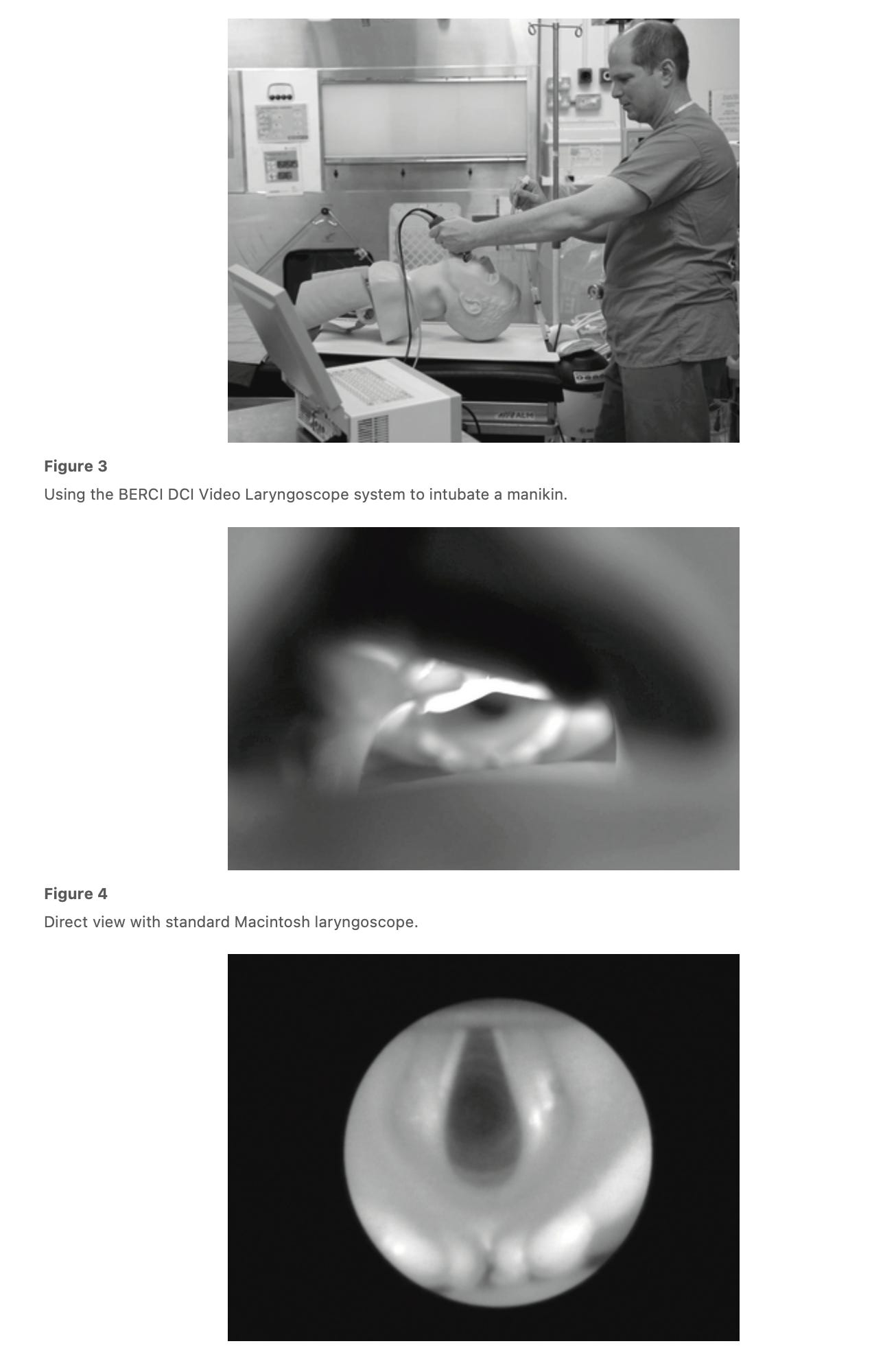
Form factor of C-Mac (miller blade or Mac blade) is exactly the same as DL. Trainee can use it without the screen, teacher can see a wide angle view at the same time. Trainee has benefit of better instruction from teacher, and better external laryngeal manipulation by assistant. If at any stage it’s deemed tricky, trainee switches eye balls in indirect video view.
It’s a win win win scenario. If you can get over the capital investment of C-Mac set up.
From Michael A. Garcia, M.D. Lighthouse Pediatric Anesthesiology
Reflecting on Ancient Roman Concrete, I believe it indeed IS related to medicine quite closely. How do we make our practices as solid as this concrete? More importantly, how do we make our practices so resilient that, when the inevitable cracks occur, that system helps fill in those cracks to create a new solid system?
From Herodotos Ellinas, MD, MHPE, Professor of Anesthesiology, Pediatric Anesthesiologist in-Chief, Academic Division Chief, Medical Director & Clinical Chief Pediatric Anesthesiology, University of Minnesota, Chair, Diversity and Sustainability Committees, Department of Anesthesiology, UM
I enjoy reading about non-pediatric anesthesia topics as part of dissemination of information. It is important for all of us to appreciate innovation and advances in technology. The Romans, Greeks, and Egyptians were all instrumental in providing us with the fundamental knowledge of so many processes we rely on today, it does not surprise me that waterproof clay is among them.