
Artificial Intelligence in Perioperative Care: Opportunities and Challenges
Myron Yaster MD, Alan Jay Schwartz, MD, MSEd, Allan F. Simpao, MD, MBI, FASA

Currently, very few of us have a practical understanding of artificial intelligence (AI) and its limitations or of the related fields of data science, computer science, informatics, and human factors engineering. In today’s PAAD, Han et al(1) provide the opening salvo in providing us with a framework to enable us to support AI integration into clinical perioperative care.
We are on the cusp of a revolution that will affect everyone, regardless of your practice type. We will do our best to summarize some of the key points of the article but as you will see, the introduction of AI into perioperative clinical care will require “standardizing data systems and workflows, assembling necessary expertise, motivating integration and adoption, instituting surveillance and validation, and establishing regulatory and ethical governance.”(1) As a profession, we’ve done this before: think of the relatively recent introduction of ultrasonography and EEG guidance of the depth of anesthesia into daily practice.
This is such a big deal, we will need to use and repurpose all of our structured educational opportunities, such as grand rounds, lecture series, journal clubs and workshops at our professional society annual meetings to get us all up to speed and enable all of us to participate in development. We should not accept this as a “black box,” and the use of AI will require rigorous validation, thoughtful governance, clinician education, and continued collaboration between medicine, engineering, and data science. I will use the PAAD to keep a close eye on all of this for you and will attempt to assemble a team of experts to help. If you have this expertise and would like to join the PAAD’s executive council please contact me at your earliest convenience. Myron Yaster MD But first a message from Stanley Kubrick’s 2001: A space odyssey,

A quick primer for readers who are new to AI: “AI” is a broad umbrella term. Machine learning is a subfield of AI that uses algorithms to learn patterns from data. These methods range from familiar statistical approaches, such as logistic regression, to decision trees, random forests, and neural networks. Deep learning uses multilayer neural networks and powers many current AI applications involving images, physiologic waveforms, and language. Generative AI creates new text, images, audio or code. Large language models (LLMs) such as ChatGPT generate text by predicting likely sequences of words with increasing sophistication and fluency.
Original article
Han L, Char DS, Aghaeepour N; Stanford Anesthesia AI Working Group. Artificial Intelligence in Perioperative Care: Opportunities and Challenges. Anesthesiology. 2024 Aug 1;141(2):379-387. doi: 10.1097/ALN.0000000000005013. PMID: 38980160; PMCID: PMC11239120.
Where AI may help
AI is rapidly emerging as a transformative technology in anesthesiology and perioperative medicine. In this Clinical Focus Review, Han et al. describe how AI has the potential to enhance perioperative care by improving clinical decision-making, patient safety, operational efficiency, and personalized medicine, while emphasizing that successful implementation requires robust validation, multidisciplinary collaboration, and careful ethical oversight. Rather than replacing anesthesiologists, AI is positioned as a decision-support tool that augments clinician expertise through analysis of complex clinical datasets.
Anesthesiology is particularly well suited to AI because perioperative care generates continuous streams of heterogeneous data, including electronic health records, physiologic waveforms, laboratory results, imaging studies, and patient-reported outcomes. Machine learning algorithms can integrate these multimodal data sources to identify patterns that may not be readily apparent to clinicians, enabling more accurate prediction of perioperative risk and real-time clinical decision support.
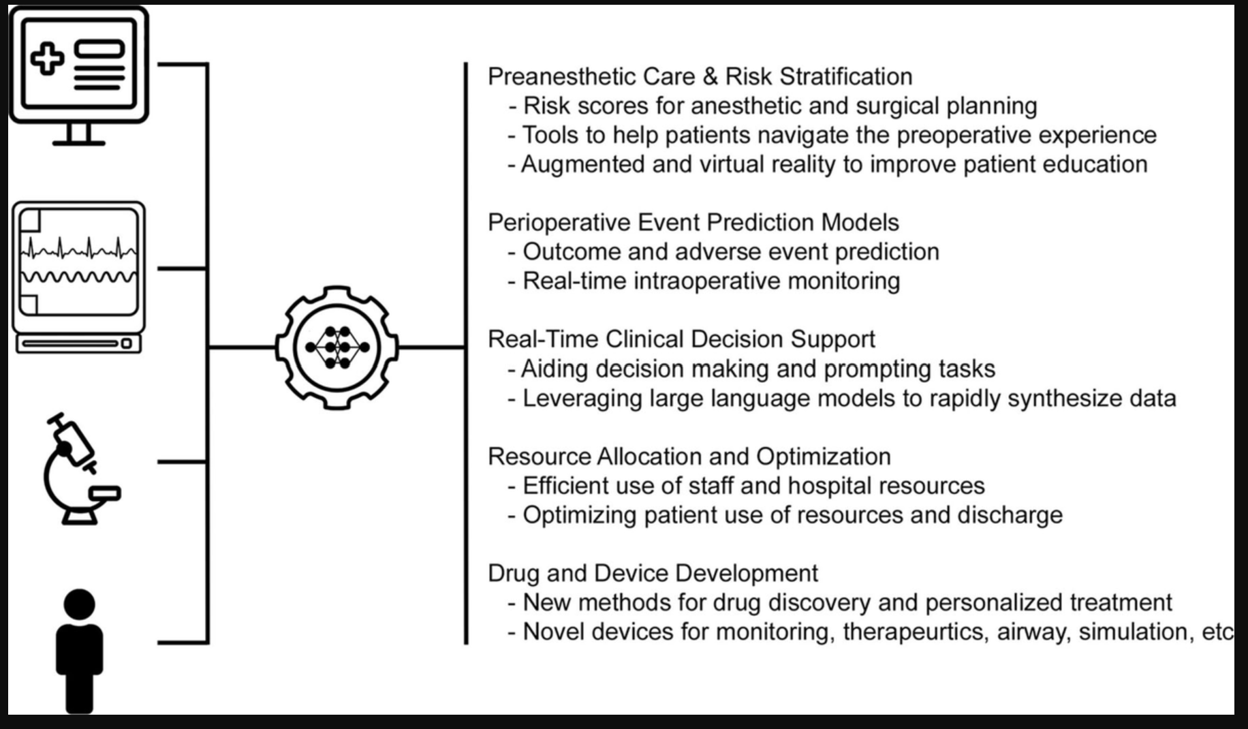
One of the most promising applications is preoperative risk stratification. Traditional risk assessment relies on population-based prediction models and clinician judgment,(2) whereas AI enables individualized prediction of postoperative complications, mortality, recovery trajectory, intensive care unit admission, and hospital length of stay by simultaneously evaluating numerous patient-specific variables. AI-powered chatbots and mobile applications may further improve perioperative care by assisting patients with appointment scheduling, providing educational materials, answering common questions, and reinforcing preoperative instructions. Virtual and augmented reality technologies also have the potential to improve patient education, reduce anxiety, and facilitate informed decision-making.(3)
AI is equally valuable during surgery through perioperative event prediction. Continuous physiologic monitoring generates large quantities of dynamic data that machine-learning models can analyze to identify impending clinical deterioration before it becomes clinically apparent. Current systems have demonstrated the ability to predict intraoperative hypotension, excessive blood loss requiring transfusion, inadequate anesthetic depth, and other adverse events, allowing earlier intervention and potentially improving patient outcomes.(4)
Figure 1 from the article illustrates how integrating clinical observations, physiologic monitoring, diagnostic testing, and patient-reported information enables comprehensive predictive modeling across multiple domains of anesthetic practice.
Han et al. highlight clinical decision support as another rapidly evolving application. AI systems can assist with medication dosing, treatment planning, image interpretation, workflow management, and evidence synthesis. The emergence of large language models (LLMs), including ChatGPT and Med-PaLM, may further improve efficiency by summarizing literature, assisting with documentation, reviewing electronic health records, and generating evidence-based recommendations.(5) However, current generative AI systems remain vulnerable to bias, fabricated information (”hallucinations”), and inaccurate citations. Consequently, at this moment in time, AI should complement and not replace expert clinical judgment.
Since Han et al. was published, generative AI has been the form of AI that many clinicians encounter and use most directly. In pediatric anesthesia, LLMs may help create developmentally appropriate and multilingual explanations for children and caregivers, generate educational cases and assessments, summarize source material, and provide first drafts of routine clinical or academic communication.(6, 7) These tools may improve efficiency, but they remain drafting and synthesis aids rather than validated clinical decision-support systems. LLMs can fabricate facts and references, omit important clinical context, and reproduce bias. Hospitals and universities are increasingly implementing secure and compliant enterprise LLMs for clinicians to use. Protected health information, confidential manuscripts, and proprietary material should not be entered into unapproved systems. Every factual claim, reference, dose, and recommendation must be checked, and meaningful AI assistance should be disclosed when appropriate.(7)
Another major area of development is closed-loop automation. AI-driven systems capable of continuously adjusting anesthetic depth, vasopressor administration, and ventilatory support have shown encouraging results in early clinical studies.(8, 9) Although these technologies may reduce clinician workload and improve physiologic stability, further validation and regulatory oversight are required before widespread implementation.
Beyond direct patient care, AI has substantial potential to improve perioperative resource management. Predictive algorithms can optimize operating room scheduling, estimate surgical duration, forecast postoperative resource utilization, and improve hospital throughput, thereby increasing efficiency while reducing costs.(10) AI may also accelerate drug and device development by facilitating drug discovery, pharmacokinetic modeling, pharmacogenomic applications, and development of intelligent monitoring systems, including ultrasound-guided regional anesthesia and automated physiologic monitoring devices.
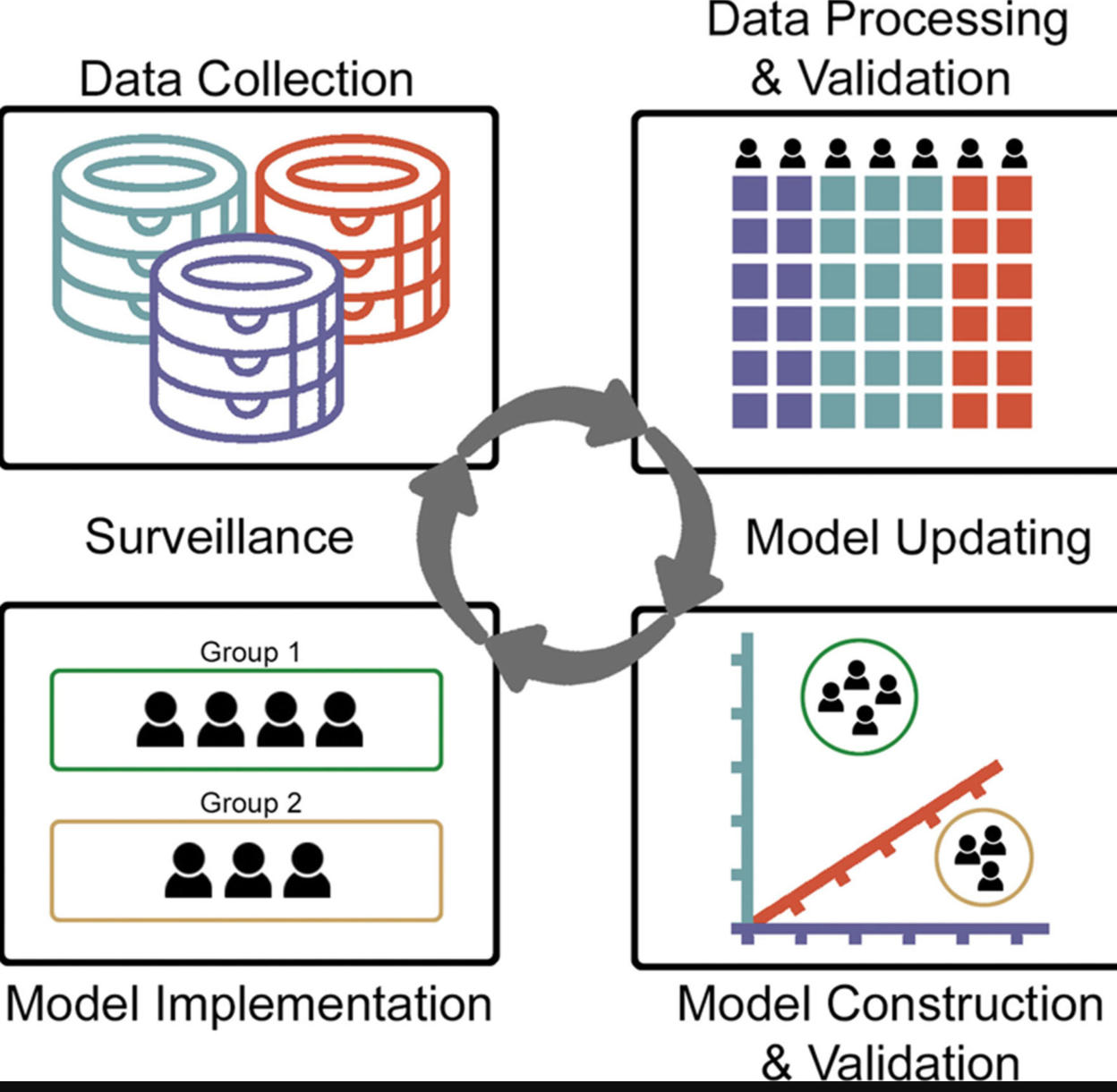
Figure 2 from the article outlines the life cycle of AI model development, emphasizing continuous data collection, validation, implementation, surveillance, and iterative model refinement.
Despite its promise, the authors identify several barriers to implementation. High-quality AI requires standardized clinical data, robust computational infrastructure, interoperability across healthcare systems, and continuous monitoring to detect performance drift (”algorithmovigilance”). Additionally, the overwhelming majority of anesthesiologists know very little about this and will require extensive education in data science and AI to facilitate appropriate adoption, interpretation, and oversight. Residency training, fellowships, continuing medical education, and multidisciplinary collaborations will be essential for successful integration.
Where does pediatric anesthesia fit?
As we all know, children are not small adults, and the pediatric anesthesia AI literature is less robust than its adult counterpart. In a recent systematic review, Antel et al.(11) identified only 40 studies of AI in pediatric anesthesia, with most focused on risk factor prediction. A subsequent review highlighted possible future applications such as closed loop nociception control, AI-assisted image-guided techniques, and gamified education.(12) Generative AI may be particularly useful for pediatric anesthesia communication and education, but pediatric-specific evaluation is essential because LLM output can still be inaccurate, developmentally inappropriate, or insensitive.(6)
Finally, ethical and regulatory considerations remain paramount. AI models may inadvertently perpetuate healthcare disparities if trained on biased datasets, while opaque “black-box” algorithms challenge transparency, accountability, and clinician trust. The authors advocate multidisciplinary governance involving clinicians, computer scientists, human-factors engineers, ethicists, implementation scientists, and regulatory agencies to ensure AI systems remain accurate, equitable, secure, explainable, and patient-centered.
Practical takeaway.
We cannot and should not all become data scientists, but all clinicians should obtain enough AI literacy to ask basic questions and remain in-the-loop from the earliest stages of AI tool design and development, not just after implementation: Was the AI model or tool trained on patients like ours? Was it externally and prospectively validated? Does it merely predict outcomes or actually improve them? Who or what monitors the tool’s performance after deployment, and who is accountable when the recommendation is wrong? In a systematic review of 103 perioperative AI and machine-learning studies, only 13% underwent external validation, and the overall risk of bias was concerning.(13)
The safest near-term role for AI is for the “A” in “AI” to stand for “augmented” rather than “artificial” or “automated,” with clinicians retaining responsibility for context, empathy, judgment, and care.
Send your thoughts and comments to Myron (myasterster@gmail.com) and he will post in a Friday reader response.

References
1. Han L, Char DS, Aghaeepour N. Artificial Intelligence in Perioperative Care: Opportunities and Challenges. Anesthesiology. 2024;141(2):379–87. doi: 10.1097/aln.0000000000005013. PubMed PMID: 38980160; PubMed Central PMCID: PMC11239120.
2. Ferrari LR, Leahy I, Staffa SJ, Johnson C, Crofton C, Methot C, et al. One Size Does Not Fit All: A Perspective on the American Society of Anesthesiologists Physical Status Classification for Pediatric Patients. Anesthesia and analgesia. 2020;130(6):1685–92. Epub 2019/06/21. doi: 10.1213/ane.0000000000004277. PubMed PMID: 31219919.
3. Ferré F, Boeschlin N, Bastiani B, Castel A, Ferrier A, Bosch L, et al. Improving Provision of Preanesthetic Information Through Use of the Digital Conversational Agent “MyAnesth”: Prospective Observational Trial. J Med Internet Res. 2020;22(12):e20455. Epub 20201204. doi: 10.2196/20455. PubMed PMID: 33275108; PubMed Central PMCID: PMC7748965.
4. Wijnberge M, Geerts BF, Hol L, Lemmers N, Mulder MP, Berge P, et al. Effect of a Machine Learning-Derived Early Warning System for Intraoperative Hypotension vs Standard Care on Depth and Duration of Intraoperative Hypotension During Elective Noncardiac Surgery: The HYPE Randomized Clinical Trial. Jama. 2020;323(11):1052–60. doi: 10.1001/jama.2020.0592. PubMed PMID: 32065827; PubMed Central PMCID: PMC7078808.
5. Dave T, Athaluri SA, Singh S. ChatGPT in medicine: an overview of its applications, advantages, limitations, future prospects, and ethical considerations. Front Artif Intell. 2023;6:1169595. Epub 20230504. doi: 10.3389/frai.2023.1169595. PubMed PMID: 37215063; PubMed Central PMCID: PMC10192861.
6. Siddiqui A, O’Reilly-Shah VN, Simpao AF, Lonsdale H. Harnessing Generative Artificial Intelligence in Pediatric Anesthesia: Enhancing Learning, Patient Care, and Family Communication. Paediatric anaesthesia. 2025;35(9):691–4. Epub 20250624. doi: 10.1111/pan.70005. PubMed PMID: 40552438; PubMed Central PMCID: PMC12343195.
7. Lonsdale H, O’Reilly-Shah VN, Padiyath A, Simpao AF. Supercharge Your Academic Productivity with Generative Artificial Intelligence. Journal of medical systems. 2024;48(1):73. Epub 20240808. doi: 10.1007/s10916-024-02093-9. PubMed PMID: 39115560; PubMed Central PMCID: PMC11457929.
8. Joosten A, Rinehart J, Van der Linden P, Alexander B, Penna C, De Montblanc J, et al. Computer-assisted Individualized Hemodynamic Management Reduces Intraoperative Hypotension in Intermediate- and High-risk Surgery: A Randomized Controlled Trial. Anesthesiology. 2021;135(2):258–72. doi: 10.1097/aln.0000000000003807. PubMed PMID: 33951140; PubMed Central PMCID: PMC8277754.
9. Liberman MY, Ching S, Chemali J, Brown EN. A closed-loop anesthetic delivery system for real-time control of burst suppression. J Neural Eng. 2013;10(4):046004. Epub 20130607. doi: 10.1088/1741-2560/10/4/046004. PubMed PMID: 23744607; PubMed Central PMCID: PMC3746775.
10. Eshghali M, Kannan D, Salmanzadeh-Meydani N, Esmaieeli Sikaroudi AM. Machine learning based integrated scheduling and rescheduling for elective and emergency patients in the operating theatre. Ann Oper Res. 2023:1–24. Epub 20230119. doi: 10.1007/s10479-023-05168-x. PubMed PMID: 36694896; PubMed Central PMCID: PMC9851122.
11. Antel R, Sahlas E, Gore G, Ingelmo P. Use of artificial intelligence in paediatric anaesthesia: a systematic review. BJA Open. 2023;5:100125. Epub 20230207. doi: 10.1016/j.bjao.2023.100125. PubMed PMID: 37587993; PubMed Central PMCID: PMC10430814.
12. Dundaru-Bandi D, Antel R, Ingelmo P. Advances in pediatric perioperative care using artificial intelligence. Current opinion in anaesthesiology. 2024;37(3):251–8. Epub 20240226. doi: 10.1097/aco.0000000000001368. PubMed PMID: 38441085.
13. Arina P, Kaczorek MR, Hofmaenner DA, Pisciotta W, Refinetti P, Singer M, et al. Prediction of Complications and Prognostication in Perioperative Medicine: A Systematic Review and PROBAST Assessment of Machine Learning Tools. Anesthesiology. 2024;140(1):85–101. doi: 10.1097/aln.0000000000004764. PubMed PMID: 37944114; PubMed Central PMCID: PMC11146190.