
Anesthesia for Ambulatory Pediatric Orthopedic Surgery
Myron Yaster MD and Santhanam Suresh, MD

In today’s PAAD, Wherritt et al.(1) examine and review current evidence regarding patient selection, anesthetic management, regional anesthesia, and procedure-specific considerations for ambulatory pediatric orthopedic surgery.
The decision to perform surgery in an ambulatory surgery center (ASC) versus a hospital is a fundamental management decision and depends on patient comorbidities, anticipated blood loss, procedure duration, and institutional capabilities. Hospitals provide immediate access to blood products, imaging, intensive care services, and specialist consultation, making them preferable for medically complex children or prolonged procedures. Conversely, healthy children undergoing routine orthopedic procedures with minimal anticipated blood loss are excellent candidates for ambulatory surgery. Studies consistently identify higher ASA classification, younger age (<2 years), prolonged operative time, and significant medical comorbidities as predictors of unexpected admission following outpatient surgery.
In today’s PAAD and in keeping with our 5-6 minute reading times, I’m going to limit our review to the section of the article devoted to regional anesthesia for children with traumatic fractures. I’ve asked one of pediatric anesthesiology’s premier regional anesthesia and ultrasound gurus and my very dear friend, Santhanam Suresh, MD, to assist. Finally, for those of you in teaching hospitals, this article is an excellent hand-out during orthopedic surgery rotations. Myron Yaster MD
Original review article
Wherritt JA, Miller GC, Patel C, Webber AM. Anesthesia for Ambulatory Pediatric Orthopedic Surgery. Int Anesthesiol Clin. 2026 Jul 1;64(3):61-68. doi: 10.1097/AIA.0000000000000518. Epub 2026 Apr 29. PMID: 42084152.
Children with fractures are among the most common patients seen by orthopedic surgeons. The operative treatment of pediatric fractures is increasing, and a growing proportion of pediatric orthopedic trauma cases are now safely managed in outpatient facilities. Common injuries, including supracondylar humerus fractures, distal radius fractures, and distal lower-extremity fractures, demonstrate excellent surgical outcomes with low complication and unplanned admission rates.
Why has regional anesthesia become so indispensable and ubiquitous? Because it is a safe and effective opioid-sparing analgesic modality that reduces opioid consumption, shortens emergency department length of stay, and is associated with high patient/caregiver satisfaction and very low complication rates.
Thus, effective perioperative pain control in pediatric ambulatory orthopedic patients relies on combining age-appropriate regional techniques with a structured multimodal pharmacologic regimen.
Procedure-Specific Considerations
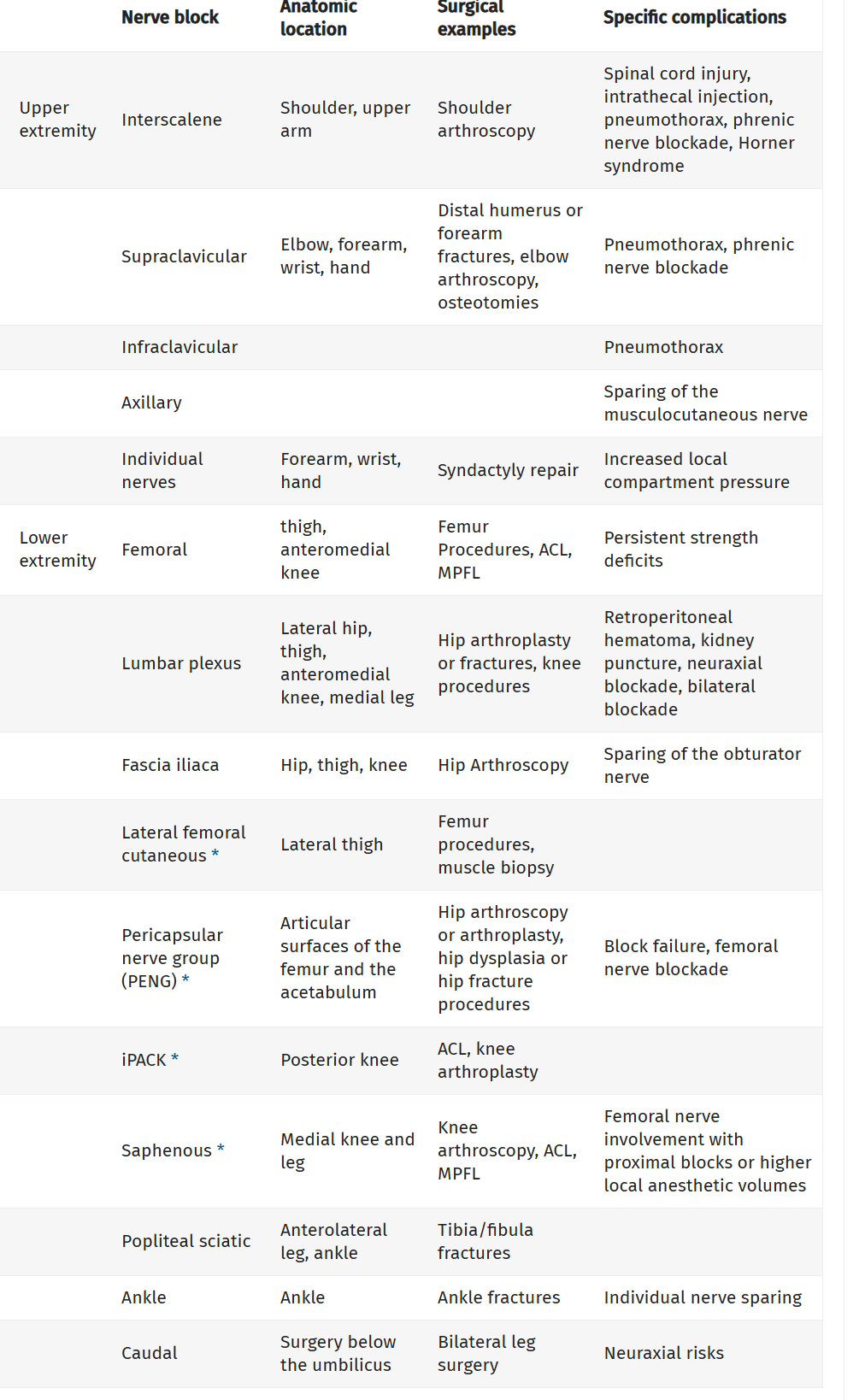
The review discusses anesthetic management for several common outpatient orthopedic procedures and is summarized in the table reproduced below:
Pediatric fractures: Careful evaluation for associated trauma, aspiration risk, and compartment syndrome is essential. Regional anesthesia should be used judiciously when postoperative neurologic assessment is necessary.
Supracondylar humerus fractures: Ultrasound-guided supraclavicular brachial plexus blocks significantly reduce perioperative opioid requirements while maintaining excellent analgesia.
Hand surgery: Digital nerve blocks or brachial plexus blocks provide effective anesthesia depending on procedure complexity and patient cooperation.
Foot and ankle surgery: Combined popliteal sciatic and saphenous nerve blocks provide superior postoperative analgesia and reduce opioid requirements.
Anterior cruciate ligament reconstruction: Motor-sparing techniques, particularly adductor canal blocks combined with IPACK blocks, improve analgesia while preserving postoperative motor assessment.
Hip arthroscopy: Multimodal analgesia combined with fascia iliaca, femoral, lumbar plexus, or PENG blocks facilitates early mobilization within enhanced recovery pathways.
Shoulder surgery: Interscalene blocks remain the standard regional technique. Particular attention must be paid to cerebral perfusion during beach-chair positioning and aggressive prophylaxis against postoperative nausea and vomiting
The 900 pound gorilla in the room:, the risk of masking a compartment syndrome, is surprisingly not discussed in the review. Although compartment syndrome is rare, the fear that the presenting sign of of compartment syndrome, namely pain, will be masked by an effective peripheral nerve block has put the fear of God, complications, and lawsuits into most pediatric orthopedic surgeon’s and anesthesiologist’s heads and prevents the use of these techniques in many patients.
The incidence by fracture type and compartment syndrome (from NEJM AI OpenEvidence)
Tibial shaft fractures carry the highest risk, with reported incidence ranging from 1.7% to 11.6% depending on the study population and inclusion of high-energy mechanisms. A 2026 study found a 2.8% rate among children admitted for observation and 3.3% among those admitted with intent to operate. The incidence is lower (1.3%) in children younger than 12 years. (2-4)
Supracondylar humerus fractures have a CS incidence of approximately 0.2–0.5% for isolated fractures, rising to 0.8% with concurrent forearm fractures (”floating elbow”). Neurovascular injury at presentation is the strongest predictor (OR 25.0). (5, 6)
Forearm fractures account for a significant proportion of upper extremity CS, with operatively treated forearm fractures and floating elbow injuries at particularly high risk.
In my (SS) personal experience, I avoid blocks in patients undergoing tibial fracture surgery. In these surgeries, compartment syndrome can happen, and in at least one case, did happen and was masked by a block. On the other hand, for upper extremity surgery, it is often the practice to have a cast that is split to allow some swelling and the likelihood of compartment syndrome is greatly reduced or eliminated. An excellent review on this topic was recently published.(7)
Do you perform nerve blocks in patients at high risk of compartment syndrome? Is it your decision or the surgeons? Send your thoughts and comments to Myron (myasterster@gmail.com) and he will post in a Friday reader response.
References
1. Wherritt JA, Miller GC, Patel C, Webber AM. Anesthesia for Ambulatory Pediatric Orthopedic Surgery. International anesthesiology clinics. 2026;64(3):61–8. Epub 20260429. doi: 10.1097/aia.0000000000000518. PubMed PMID: 42084152.
2. von Keudell AG, Weaver MJ, Appleton PT, Bae DS, Dyer GSM, Heng M, et al. Diagnosis and treatment of acute extremity compartment syndrome. Lancet (London, England). 2015;386(10000):1299–310. doi: 10.1016/s0140-6736(15)00277-9. PubMed PMID: 26460664.
3. Villarreal ED, Wrenn JO, Sheffer BW, Sawyer JR, Spence DD, Kelly DM. Do Patient-specific or Fracture-specific Factors Predict the Development of Acute Compartment Syndrome After Pediatric Tibial Shaft Fractures? Journal of pediatric orthopedics. 2020;40(3):e193–e7. doi: 10.1097/bpo.0000000000001410. PubMed PMID: 31157755.
4. Ball GA, Thompson EA, Bomar JD, Edmonds EW. Pediatric Acute Compartment Syndrome in Midshaft Tibia Fractures: Risk Factors for Overnight Observation. Journal of pediatric orthopedics. 2026. Epub 20260414. doi: 10.1097/bpo.0000000000003291. PubMed PMID: 41979152.
5. Robertson AK, Snow E, Browne TS, Brownell S, Inneh I, Hill JF. Who Gets Compartment Syndrome?: A Retrospective Analysis of the National and Local Incidence of Compartment Syndrome in Patients With Supracondylar Humerus Fractures. Journal of pediatric orthopedics. 2018;38(5):e252–e6. doi: 10.1097/bpo.0000000000001144. PubMed PMID: 29529005.
6. Armstrong DG, MacNeille R, Lehman EB, Hennrikus WL. Compartment Syndrome in Children With a Supracondylar Fracture: Not Everyone has Risk Factors. Journal of orthopaedic trauma. 2021;35(8):e298–e303. doi: 10.1097/bot.0000000000002030. PubMed PMID: 33252445.
7. Lönnqvist P-A, Ecoffey C, Bosenberg A, Suresh S, Ivani G. The European society of regional anesthesia and pain therapy and the American society of regional anesthesia and pain medicine joint committee practice advisory on controversial topics in pediatric regional anesthesia I and II: what do they tell us? Current Opinion in Anesthesiology. 2017;30(5):613–20.